
Bog Turtle General Info
The adorable little Bog Turtle is actually one of the smallest of all the turtle breeds on the planet. Also known as the Muhlenberg’s Turtle, this breed is rare and endangered. For these reasons, it is best to ensure that you get your Bog Turtle from a reputable breeder or from an adoption center.
The adorable little Bog Turtle is actually one of the smallest of all the turtle breeds on the planet.
Native Habitat

In terms of its natural wild habitat, you will only be able to find the Bog Turtle living in the United States. It is found in several states on the eastern part of the country. These include Connecticut, Massachusetts, New York, New Jersey, Pennsylvania, Maryland, and Delaware. Plus, they could also be found in Virginia, Tennessee, North Carolina, South Carolina, and Georgia. Generally, these turtles prefer to spend their time in marshy areas, swamps, and bogs, as well as slow-moving streams. They also like to live in habitats that have a soft substrate and low-growth vegetation.
Overall Description
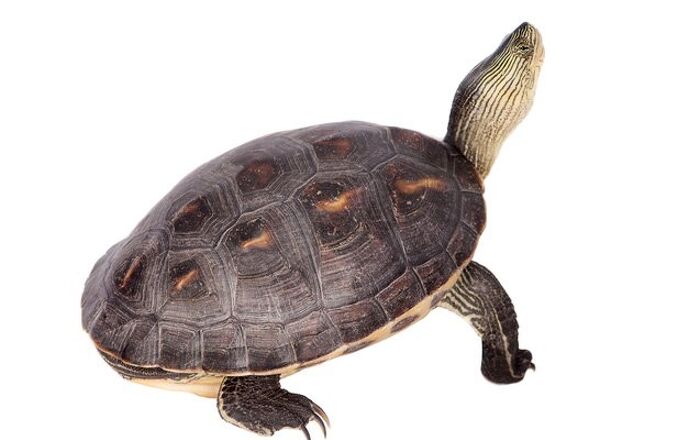
Little Bog Turtles are super cute because they are so small. They also have a shell that is slightly elongated. Juveniles will have a shell that is rough in terms of its texture. However, that roughness will become smoother as the turtle gets older, especially because these animals like to burrow a lot.
You could differentiate a male Bog Turtle from a female by their tails and plastrons. A male will feature a thicker and longer tail, as well as a moderately concave plastron. A female will have a flat plastron and a shell that is wider and more domed in appearance.
Also known as the Muhlenberg’s Turtle, this breed is rare and endangered.
Colors
It could be easy to spot a Bog Turtle, thanks to the bright red, yellow, or orange blotch that is found on each side of the animal’s head. The shell could be anywhere from a brown color to black, and every bony plate on the shell typically will feature a light colored center as well. The plastron will also be either brown or black, and it will feature some light markings in an irregular pattern too. Finally, the skin of the Bog Turtle will be brown or black, and it might also be speckled or streaked with orange or red markings, particularly on the edges of the scales on the legs.
Environment

In terms of housing, the Bog Turtle could do well in a fairly simple enclosure. The key is to provide your pet with equal areas of shallow water and land so that you could mimic this breed’s natural habitat. A single Bog Turtle could do well in a 3’ x 2’ tank, at a minimum, while two turtles would require double this amount of space. Also make it a point to set up various hiding spots and sightline breaks throughout the enclosure as well, especially if you have more than one turtle.
Choose a soft substrate, such as fine mulch or leaf litter, to cover the dry area of the enclosure. Shelters in the form of hollow logs, as an example, are also necessary, and they should be big enough that your pet could easily turn around inside comfortably. And you could also add some plants in the dry area, as these could provide more hiding places for your pet.
For the aquatic area of your enclosure, you may not need any substrate. However, you should be able to give your turtle access to water that varies in depth. Just don’t make the water any deeper than the length of your pet’s shell. Proper filtration, and a system that allows you to totally change the water regularly, will also be necessary to keep the water clean.
A basking area should have a UVB light above it, and a heater should ensure the temperature ranges from 85-90°F. Air temperatures could be maintained anywhere from 75-85°F, and water temperatures could be maintained at 65-75°F.
Using heaters and electrical timers, you could adjust the amount of light that your turtle is exposed to throughout the year so that you could mimic the seasons that the animal would be exposed to in the wild. During the summer, provide 16 hours of daylight, and then limit that to 10 hours of light during the winter.
Bog Turtles can be a lot of fun to keep as pets.
Care Requirements
The Bog Turtle is an omnivore that enjoys feasting upon a variety of foods. These include dragonflies, ants, millipedes, and beetles, as well as slugs, spiders, earthworms, and snails. These turtles could even eat mice, voles, nestling birds, and frogs. And they won’t mind munching on plants either, such as seeds and berries.
To mimic its wild diet, you could provide your Bog Turtle with commercial pellets for turtles, as well as insects like roaches and crickets. On top of that, you could give your pet some cut fish, aquatic plants, earthworms, green leafy veggies like romaine lettuce, grapes, melons, and strawberries.
Behavior
Bog Turtles can be a lot of fun to keep as pets, and they are smart animals that will learn to recognize their owners and come out to ask for food. If you are planning on keeping more than one of these turtles, though, it is best to house the males separately because they could end up fighting over territory.
Photo credit: Jay Ondreicka/Shutterstock.com