Boulonnais Horse Breed History
Considered the most elegant of all of the equine draft breeds, the Boulonnais Horse is also referred to as the White Marble Horse. And its origins date back to a time before the Crusades, so this breed has been around for a long time. In fact, according to some experts, these horses are from the Boulogne District in France, and you can trace them all the way back to the animals that were left behind by the cavalry of Julius Caesar prior to invading England.
Over time, the Boulonnais horse was bred with several other equine breeds in order to refine it. And this breed has also been used to develop other draft breeds as well. For example, during the 17th century, Andalusian, Arabian, and Spanish Barb horses were bred with the Boulonnais.
The Boulonnais has a social and docile personality.
Also, originally, this breed had several types as well. For example, the Petit Boulonnais, or Mareyeur, was smaller, coming in at around 15 hands tall, and it was typically used to transport fresh fish. The Picard type was referred to as the “horse of the bad land,” while the Cauchoix horse was referred to as the “horse of the good land.” Finally, the Grand Boulonnais, which could reach 16 hands in height, was bred for working on farms. Over time, the types were bred together and led to the modern type we know today.
Boulonnais horses were exported to the United States in the early part of the 1900s, but these animals nearly went extinct in Europe as a result of the wars of the 20th century, and particularly after World War II. Thankfully, the breed was able to make a bit of a comeback in the 1970s in France, but it was because the animals were being used for meat.
Today, there aren’t that many Boulonnais horses alive anymore, and the majority of them are found in France.
Breed Traits
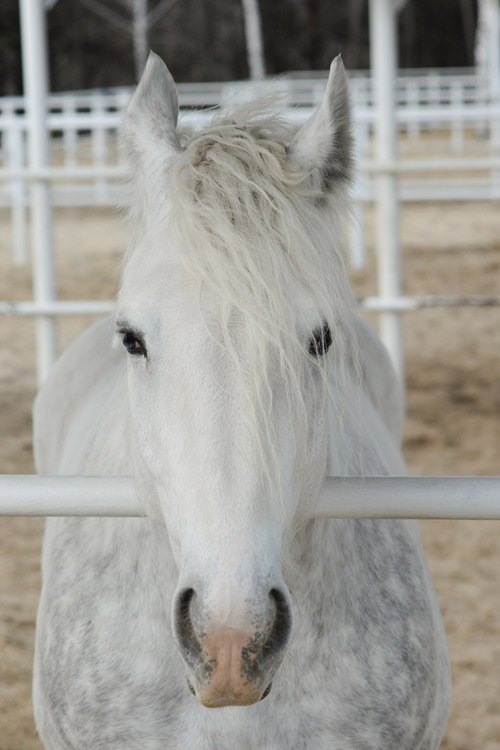
Don’t let the height and strength of the Boulonnais horse intimidate you, as these horses are known for being easy to work with. They are active, social, and energetic as well, making them wonderful companions. And they are also gentle, so they can be around owners and riders of all experience levels, despite their large size.
Because these horses are attractive, strong, and capable, and because they have a willing and docile personality and the ability to do a range of tasks, they make great horses for just about anybody.
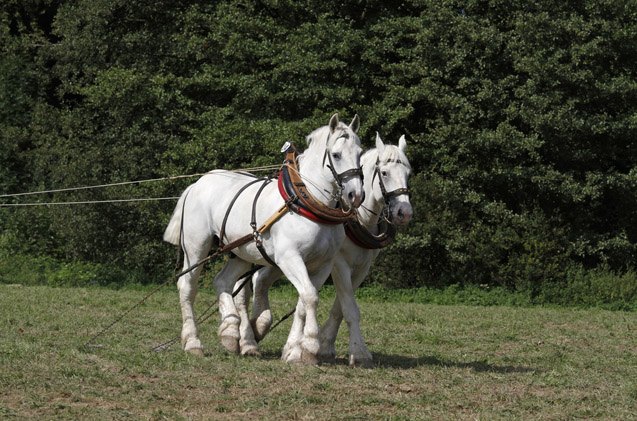
The Boulonnais horse is typically gray in color.
Overall Description
These large, elegant horses are refined and stunning in appearance. You will notice that these horses have a head that is short yet distinctive. There is a forehead that is wide, a profile that is straight, and ears that are erect and small. Also, the neck should be muscular and thick, as well as arched gracefully, and the chest should be wide, while the withers should be prominent. Compared to other draft horses, the muscular shoulder has more slope and the tail is set higher. And the back should be straight, while the legs should be solid and strong and feature clean joints.
Also, the tail and the mane are a couple of the other lovely features of these horses, as they are described as thick, silky, and luxurious. And you may also note that the skin of the Boulonnais is quite fine too, allowing you to see some veining and giving the horse the appearance of polished marble (hence, the breed’s nickname).
The Boulonnais is also referred to as the White Marble Horse.
Colors
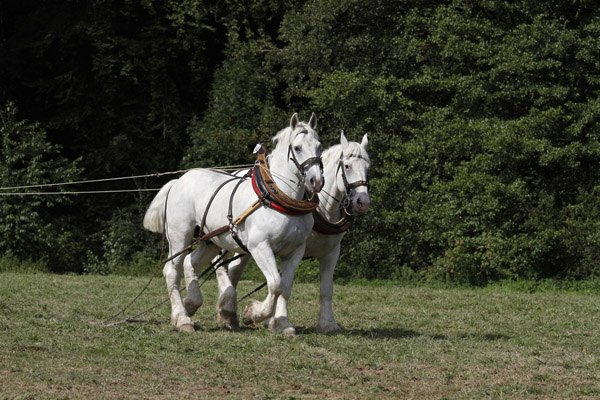
The Boulonnais horse is typically gray in color. However, black and chestnut are also colors that are allowed by the breed registry in France. According to experts, the most common colors for this breed were actually black and bay back in the 18th century. But as the breed’s numbers started to decline, a dominant gray gene caused the other colors to become increasingly rare.
Grooming Requirements
Grooming your Boulonnais horse may be a little difficult because these animals are large, but it will be well worth the effort. Not only will you be able to bond with your horse, but you will also help ensure that his lustrous coat and full mane and tail will remain looking healthy and beautiful.
When your horse gets too dirty for a basic brushing routine, you could bathe him with a gentle shampoo that is designed for equines. On a regular basis, however, brushing with a curry comb, a dandy brush, a body finishing brush, shedding blade, and a brush for the tail and the mane, should be sufficient, as these will help remove dirt, debris, and loose hair from the coat. You will want to pay special attention to the mane and tail, which are thick, so that you can properly clean them and detangle them so that they will be nice and smooth. Using a moistened soft cloth around the eyes and ears will allow you to clean those delicate areas as well. And, of course, a hoof pick will be necessary to completely clean the hooves of dirt and debris that can collect from daily activities.
Photo credit: Bildagentur Zoonar GmbH/Shutterstock; Anastasiia Pliekhova/Shutterstock