Chinese Shar-Pei Basics
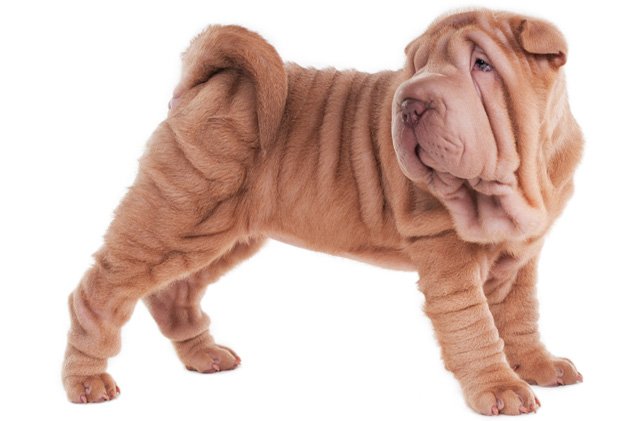
Let’s put it this way: when you own a Chinese Shar-Pei, you know you own a Chinese Shar-Pei. It’s one of the most distinctive-looking breeds available – certainly one of the dog breeds that makes other uninitiated dog lovers ask “what breed is that?” Well, they have good reason to be curious: this is actually one of the rarest breeds out there and despite its relatively rich history – considering the breed’s numbers – it was not officially recognized by the American Kennel Club until 1991.
The chances are if you’re looking for a Chinese Shar-Pei, you’re going to have more difficulty than simply making the decision of choosing the right breed for you. Acquiring this dog can be a bit difficult, but for many people, the adventure is worth it. A Shar-Pei can be a very protective dog that bonds well to a close-knit group of people, but without proper handling and training from a young age, it can become a bit territorial. Let’s find out more about this impressive and rare breed of dog that will certainly become a main attraction wherever you decide to take it.
A Shar-Pei can be a very protective dog that bonds well to a close-knit group of people.
Origin
Where else could the Chinese Shar-Pei come from if not China? Its name roughly translating from Mandarin into English as “sand skin,” the origin is similar to that of many old Chinese breeds like the pug. In other words, it goes back through a lot of history. Although no definitive dates are available regarding the early development of the Shar-Pei, historians believe it can be traced to the Guangdong province and southern provinces of China.
During their early days in China, the Chinese Shar-Pei would be used for a number of reasons, often by peasants: the dogs could be used for protection, for hunting, and for herding animals. This has given the modern version a certain athletic versatility and a wide taste for different types of both exercise and play. As time went on, the Chinese Shar-Pei was also used in the upper classes as a fighting dog, although this practice went out of style after the Communist revolution.
After the Communist revolution in China, the Shar-Pei population was nearly wiped out, and to this day it is among the rarest breeds in the world.
Pedigree
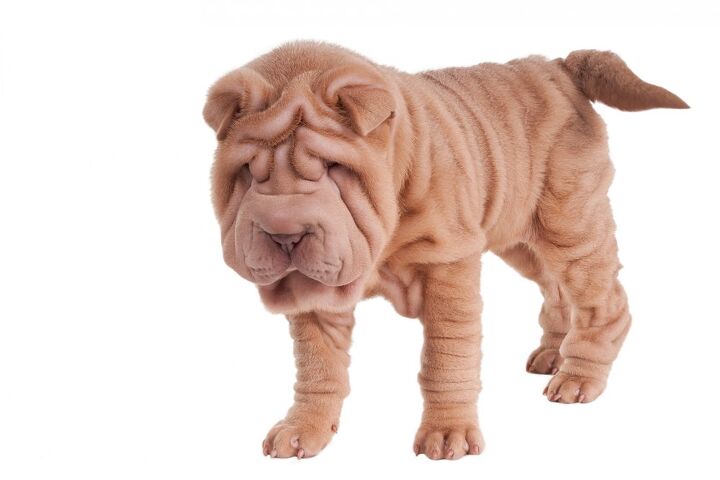
Although the pedigree of the Shar-Pei is not exact, there are some experts that can trace the relatives of this dog to those of other breeds. For example, it is believed that the Shar-Pei shares a common ancestor with the Chow-Chow, thanks to some similar appearances including their tongues. The Great Pyrenees are considered another possible relative, as are the Tibetan Mastiffs. This gives them a lot of links with dogs in Asian history.
Chinese Shar-Pei’s have been bred over the years for a number of tasks. Unfortunately, dog fighting is one of the influences in this dog’s past. But other tasks, such as herding animals, have influenced the modern Chinese Shar-Pei’s behavior and made it a willing companion for a variety of tasks.
Food / Diet
A Chinese Shar-Pei should have a healthy and even voracious appetite at times has a relatively large frame. Good meats and poultry are considered healthy and natural foods for a dog of this type, and it’s important to remember to incorporate other whole ingredients into a dog’s diet so as to maintain a healthy coat and body.
It’s also important to remember that regular exercise should be considered part of a healthy overall daily regimen for this breed.
It is generally a gentle dog and is even considered quiet when it has no other reasons to bark.
Training
The proper training and socialization of a Chinese Shar-Pei from a young age is very crucial in its development. Because it can have a higher propensity to territorial aggression and can be a little worried around strangers, it should get used to the idea of other humans and should be able to realize that being around them is safe. Training will also require a good degree of patience. If you’re a first-time dog trainer, the Shar-Pei is not the ideal dog to “cut your teeth” on.
Weight
Weighing around 55-65 pounds in males and 40-55 pounds in females, this could be considered a relatively large but still medium-sized dog.
Temperament / Behavior
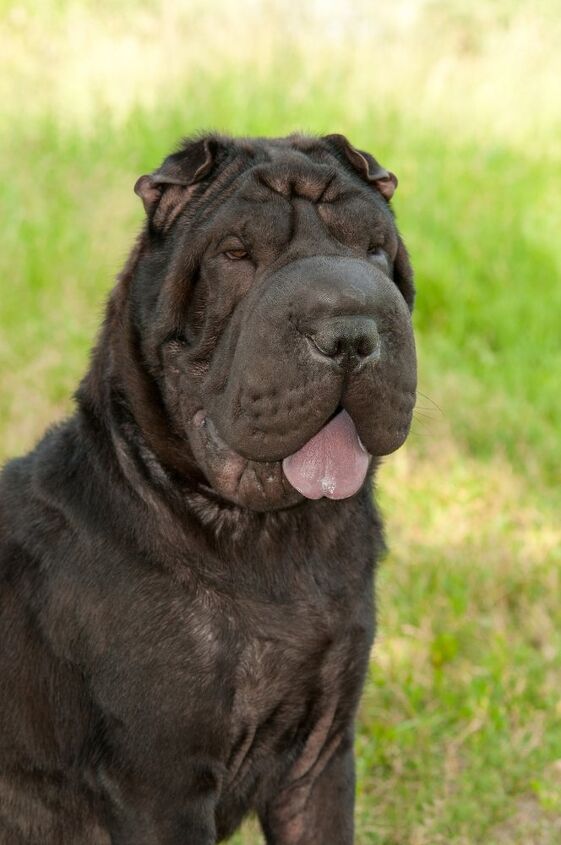
The aforementioned territorial behavior is a remnant of the Chinese Shar-Pei’s role as a guard dog in years past, as well as its dog fighting history. It is generally a gentle dog in other cases, however, and is even considered quiet when it has no other reasons to bark.
Common Health Problems
Because of their deep wrinkles, skin problems and infections can plague this breed, which means regular cleaning and bathing will be called for. Familial Shar-Pei Fever (FSF) is a disease named specifically for this breed, and it usually lasts for about 24 hours. These fevers can come and go in the breed.
Life Expectancy
A high degree of variance in their life expectancy: a Shar-Pei can often live anywhere from 7-15 years.
Exercise Requirements
Like almost all dog breeds, daily exercise will be pretty important in handling your relationship with the Shar-Pei, as well as maintaining a good health regimen. The Shar-Pei enjoys a variety of exercises, as well.
The Chinese Shar-Pei is actually one of the rarest breeds out there.
AKC
Only recognizing this breed in 1991, the American Kennel Club describes the Shar-Pei as “aloof and standoffish with strangers, but devoted to his family.”
Coat
The coat of the Shar-Pei should be rough. Their wrinkles are a distinctive feature – as puppies they will be even more wrinkled than an adult. Regular cleaning and clipping is encouraged, but the Shar-Pei is otherwise not a very high-maintenance breed.
Puppies
As a puppy, a Shar-Pei will have a coat full of wrinkles that it eventually “grows” in to. This will require extra attention. Additionally, Shar-Pei puppies should be properly socialized and trained from a young age.
Photo credit: Vitaly Titov & Maria Sidelnikova/Shutterstock