
Loggerhead Musk Turtle General Info
The Loggerhead Musk Turtle is one of several Musk Turtle species. These small turtles make great pets, including for beginners. However, you should be aware that, when these animals become extremely stressed, they will end up releasing a yellowish liquid from glands that are found beneath the carapace rim. This liquid will be foul smelling, and it is their defense mechanism against predators. Nevertheless, these turtles are popular in the pet trade because they are easy to manage and they are responsive and personable.
The Loggerhead Musk Turtle is one of several Musk Turtle species.
Native Habitat

You can find Loggerhead Musk Turtles throughout the southeastern portion of Alabama, from the Apalachicola River drainage to Tensaw River, as well as in Tennessee, Louisiana, Mississippi, Georgia, and Florida.
These turtles prefer slow moving creeks, streams, and rivers that have a soft bottom. You can also find them in lakes and ponds.
Overall Description
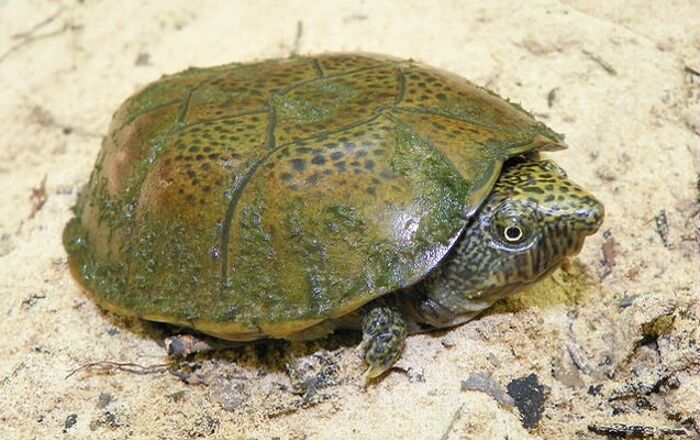
The Loggerhead Musk Turtle features a keeled carapace. When looking at these turtles, you will also notice that they have a fairly large head, and it is the size of their head that contributed to their common name.
You will also note that the carapace of the Loggerhead Musk Turtle is a bit serrated. It also features lateral keels, which might go away as your turtle gets older, along with a vertebral keel. This turtle’s snout is described as tubular, and it feature barbels on its chin.
Loggerhead Musk Turtles make great pets, including for beginners.
Colors
The carapace of the Loggerhead Musk Turtle will be orange, dark olive, or brown, and it will also feature dark colored seams. The shell could showcase dark streaks or spots, while the body and the head of this turtle will be orange, light brown, gray, or pink and also feature dark colored markings like splotches and spots, but it might even have yellow stripes. The plastron will typically be anywhere from yellow to pink in color.
Environment

This aquatic turtle breed will need a large sized tank that will allow for complete submersion and comfortable swimming. In other words, the enclosure for your Loggerhead Musk Turtle should have deep water. The minimum enclosure for this breed would be a 30-gallon tank. However, if you are going to be housing more than one turtle in the same tank, you will need to provide them with additional space.
Also, even though these turtles do not bask frequently, you will need to provide an area where your pet can climb out of the water to dry off. You can create a basking area easily using a rock that projects from the water, but young turtles might also do fine with floating aquatic plants that are non-toxic.
Keep in mind that these turtles are active, and they are messy eaters. Therefore, you will need to invest in a high quality filtration system that will keep the water in the enclosure as clean as possible. In terms of substrate, you can keep the bottom of the tank bare or you can opt to put down river pebbles.
It is also important to maintain the temperature in your Loggerhead Musk Turtle’s enclosure. The air temperature should remain between 75-83°F, while the basking area should have a heater over it in order to ensure it reaches the mid 80s to low 90s Fahrenheit. Finally, a high quality water heater should be used to keep the water temperature anywhere from the mid to high 70s Fahrenheit.
Once Loggerhead Musk Turtles become comfortable, they will be quite responsive and outgoing rather than shy.
Care Requirements
You can feed your Loggerhead Musk Turtle a high quality commercial pelleted diet that is designed for turtles. On top of that, you can also give your pet fish, worms, aquatic insects, and snails.
Behavior
Rest assured that, once your Loggerhead Musk Turtle becomes comfortable in your home and in his enclosure, the odds of him releasing the foul smelling liquid will be slim. Also, once these turtles become comfortable, they will be quite responsive and outgoing rather than shy.
If you wish to establish a community tank with multiple turtles, Loggerhead Musk Turtles will do well with Sliders, Cooters, and Painted Turtles. They can typically live peacefully with these other species because they prefer living in deep water while the other species bask. Just make sure you provide plenty of room in the enclosure for all of the turtles to be comfortable, and all of the other species in the enclosure should grow to be roughly the same size as your Loggerhead Musk Turtle. Finally, use caution if housing multiple Musk Turtles together, as males could become aggressive.
Only handle your Loggerhead Musk Turtle when it is really necessary to do so. These animals have strong jaws that can produce a painful bite when agitated.
Photo credit: Nicole Buchmann/Wikimedia; Greg Hume/Wikimedia; robertpoirier23/Flickr