Lusitano Horse Breed History
Both the Andalusian Horse and the Lusitano Horse can be traced back to the Sorraia Horse of the Iberian Peninsula. The Sorraia dates back to 20,000 B.C., making it a primitive breed, and it is even found on cave paintings. When the Celt and Phoenician traders brought horses to the Iberian Peninsula from northern Africa around 900 B.C., those horses bred with the Sorraia.
Despite their common ancestry, the Lusitano and the Andalusian are quite different. In the 17th century, the Spanish no longer used horses in bullfighting, so they began breeding the Andalusian Horse for pleasure riding instead.
Lusitano horses are filled with a lot of energy, so they need to be exercised regularly.
On the other hand, the Portuguese continued to use the Lusitano Horse in bullfighting, so they wanted to maintain the characteristics of the breed that were already popular at the time. These features included agility, calmness, and bravery, particularly when it came to moving towards a threat. In addition to bullfighting, the Lusitano Horse was also utilized as a workhorse for pulling carriages, as well as for farm work, but it was even used as a cavalry mount.
The Lusitano Horse and the Andalusian Horse shared the same registry until the 1960s, when breeders of the Lusitano wished to emphasize the unique features of this breed.
Portuguese breeders created a studbook in order to set Spanish Andalusians apart from their Andalusians. Therefore, in 1966, the official Lusitano registry was formed, and the breed’s official name became Puro Sangue Lusitano.
Breed Traits
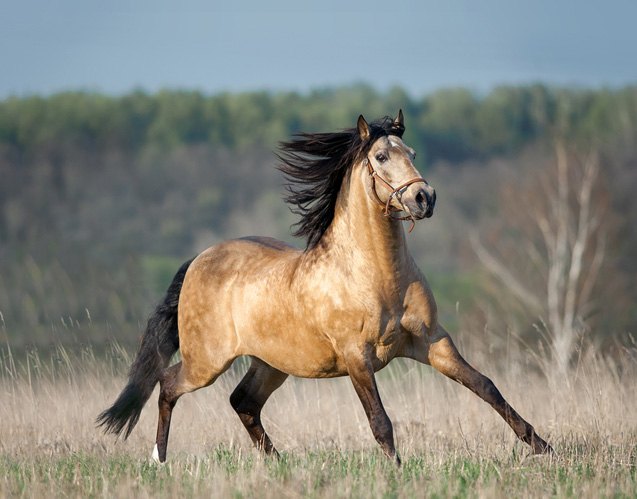
Lusitano horses are known for their endearing personality. These animals are enthusiastic, kind, generous, and noble. They are also gentle, friendly creatures that work well with any level of rider and trainer because they are able to concentrate and focus on the task at hand. Plus, these horses are revered particularly for their courage, as well as their cool head even when faced with a difficult situation, so they are able to remain calm and easy to manage.
These animals are filled with a lot of energy, so they need to be exercised regularly. They are also fast learners, and they are loyal. Therefore, owners who have plenty of time to spend with their horses are ideal for the Lusitano. Those who are able to provide their horses with the activity and enrichment that they require will do best with this breed.
The Lusitano requires extra attention and care to maintain the beauty of its thick tail and mane.
Overall Description
The Lusitano breed has a noble appearance. It features a head that is medium in length, well proportioned, and narrow. These horses also have a lower jaw that is somewhat unpronounced, although the cheek will be long.
The forehead features a rounded profile, and the medium-length ears are expressive, narrow, and fine. The eyes are almond shaped, large, confident, and expressive. And the neck is also medium in length, but it is arched and features a hairline that is narrow.
This horse’s withers will be long and well defined, as well as higher than the croup. Also, there will be a smooth transition from the animal’s back to the neck. The chest is muscular, deep, and medium in size as well, while the shoulders are muscular, slanting, and long. Even the ribcage is well developed, deep, and long, with the ribs arching diagonally into the horse’s spine, creating a full and short flank.
Finally, when looking at this horse, you will also notice that its legs are long and slender, the whole body is compact with a short back, and the tail and the mane are full and wavy.
When comparing the Lusitano to the Andalusian, it is clear that the head is more convex, the croup is more sloping, and the tail is set lower.
Lusitano horses are known for their endearing personality.
Colors
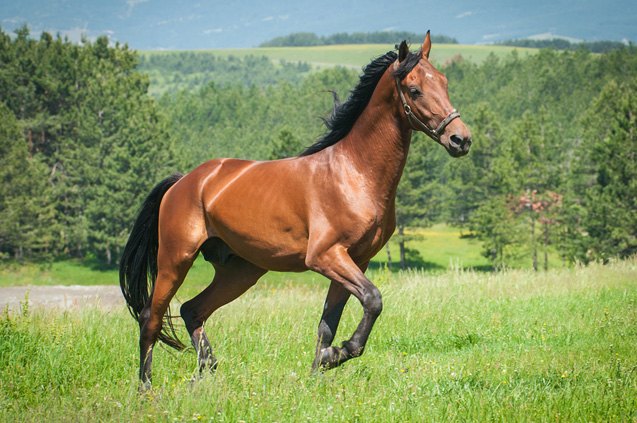
The Lusitano Horse can be found in any solid color; however, bay and gray are the most common colors. Other possible colors include chestnut, black, dun, and palomino.
Grooming Requirements
In addition to the standard grooming procedures that you would follow with any equine companion, the Lusitano Horse requires a bit of extra attention and care in order to maintain the beauty of this breed’s thick tail and mane.
Standard grooming tools, including a curry comb, body finishing brush, dandy brush, mane comb, tail brush, and hoof pick, can be used on a Lusitano on a consistent basis in order to keep the horse looking healthy, clean, and beautiful.
Photo credit: i_love_nature/Bigstock; Anastasija Popova/Bigstock; zorandim/Bigstock