Thoroughbred Horse Breed History
The Thoroughbred horse dates back to the 17th and 18th centuries. They evolved in Britain, where people had an interest in racing horses. British citizens had already been breeding horses for running, and it was King Henry VIII who founded the royal racing stables.
This unique breed actually has three founding stallions, which were Arabians. However, even though the Thoroughbred was created with the intention of being used as a racehorse, none of these founding stallions were ever raced.
Thoroughbred Horses have bold and spirited personalities that are not suitable for riders and owners who do not have experience.
The three principle pedigree bloodlines of the Thoroughbred Horse were the Byerly Turk, the Darley Arabian, and the Godolphin Arabian. All of these horses were imported into England in order to be bred with domestic mares and native, select racing stock. Therefore, all of the modern Thoroughbred horses today are descendants of these three stallions within the male line. Also, more than 80% of this equine breed’s genes descend from 31 original ancestors.
Successful breeding resulted in a horse that was fast and strong, and that had the endurance to work over extended distances. The Thoroughbred is graceful and powerful, so it became the most highly regarded and preferred racehorse throughout America, England, and other parts of the world. In fact, this horse is the most popular racing equine breed on the planet today.
Breed Traits
Overall, the Thoroughbred Horse is such a popular breed because it makes a wonderful companion for experienced riders who enjoy racing and a range of other equine activities. These horses are highly intelligent, and they also have a strong work ethic.
However, because the Thoroughbred Horse is a hot-blooded equine breed, these racehorses have bold and spirited personalities that are not suitable for riders and owners who do not have experience.
To get along well with a Thoroughbred, you will need to have the confidence, knowledge, and experience necessary to properly channel this horse’s high energy. If you are an intermediate rider or an advanced horse handler, however, you can enjoy a flowing, powerful, and smooth ride on this incredible animal.
This breed truly exudes elegance, power, and grace all at once, so owners can train them in a variety of disciples, from dressage and polo, to show jumping, racing, and more.
The Thoroughbred was was bred for speed, athleticism, and stamina, and can reach up to 40 miles per hour.
Overall Description
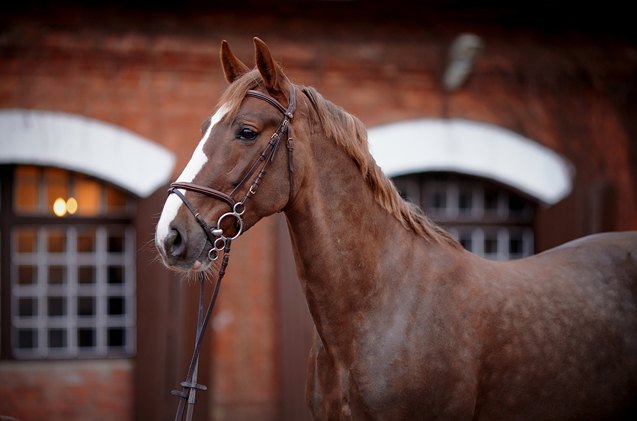
The Thoroughbred Horse, which was bred for speed, athleticism, and stamina, is so strong that it can reach up to 40 miles per hour while running. These horses are also bred to become mature at an early age because the prime racing years for horses is from 2 to 3 years.
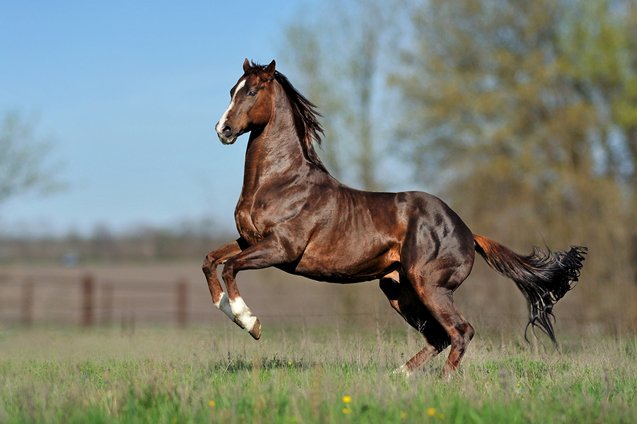
This breed features a long neck that is actually slightly longer than the average neck, as well as a refined and chiseled head that showcases widely spaced eyes. The fine head of the Thoroughbred Horse also features a straight profile that lacks their ancestors’ Arabian dish.
When looking at a Thoroughbred, you will note that these horses have deep shoulders, a short and evenly curved back, a strong and deep chest, well-defined and high withers, and strong hindquarters. Also, the muscles throughout the body are lean, and the legs are long and clean. Despite being so large, powerful, and muscular, however, these horses are elegant and graceful.
One of the main reasons why Thoroughbred horses are so fast is because there is a lot of distance between the hock and the hind hip. When these horses gallop, they can get maximum thrust as a result of their physique, and they also enjoy maximum lung expansion, thanks to the girth depth.
The Thoroughbred is the most popular racing equine breed on the planet today.
Colors
The beautiful Thoroughbred Horse has many different solid coat colors. Horses can be gray, bay, dark bay, roan, chestnut, white, buckskin, black, perlino, palomino, cremello, and brown.
These horses can also feature white marking on the face, as well as white markings on the legs below the knees. They can be marked with blazes, socks, stockings, or stars, but white markings typically will not be found on the animal’s body.
Grooming Requirements
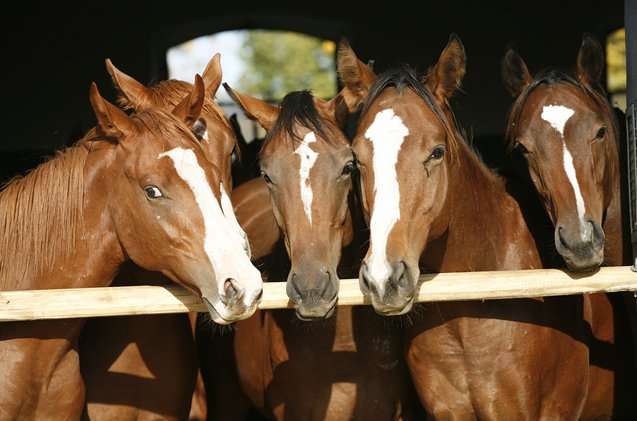
When grooming a Thoroughbred, you should be gentle because this is a breed with a thinner skin than other breeds, so they are more sensitive and can become irritated more easily. Also, racehorses may be dealing with muscle soreness, and hot-blooded equines are quite spirited, so they may not be as easy to handle as other breeds during grooming sessions.
For the best results, you should identify spots throughout the horse’s body where it will tolerate grooming. These can be referred to as “yes spots” and “no spots.” Work more gently and slowly in “no spots,” and provide rewards along the way. It will also help to take breaks during the grooming session.
For a Thoroughbred, you can replace a stiff curry comb with a jelly scrubber, dry sponge, or rag. Alternatively, you could utilize a washcloth over your curry comb to make it gentler. You can even use tools that have natural bristles, rather than nylon options, for more softness.
Finally, move slowly and with a soft touch, unless you find that your horse actually prefers a stronger touch. Laying the brushes parallel to the body before sweeping can help prevent excessive contact of the ends of the bristles with the horse’s skin as well.
Photo credit: accept/Bigstock; Anaite/Bigstock; AZALIA/Bigstock