Alabama Map Turtle General Info
The Alabama Map Turtle is a beautiful breed that is protected in Alabama and rare in Georgia. This is a good breed to start with if you are a beginner turtle keeper.
The Alabama Map Turtle is a beautiful breed that is protected in Alabama and rare in Georgia.
Native Habitat
Alabama Map Turtles could be found in several rivers and streams in Georgia and—you guessed it—Alabama. These rivers include the Tombigbee, the Tensaw, the Tallapoosa, the Black Warrior, the Alabama, and the Coosa rivers. They can also be found in Florida, Louisiana, and Mississippi.
These turtles seem to prefer both rocky streams and large, muddy rivers. Males and juveniles will often be seen in shallower habitats, and they also like to bask on piles of brush or on fallen logs. Females, on the other hand, prefer to spend their time in deeper waters.
Overall Description
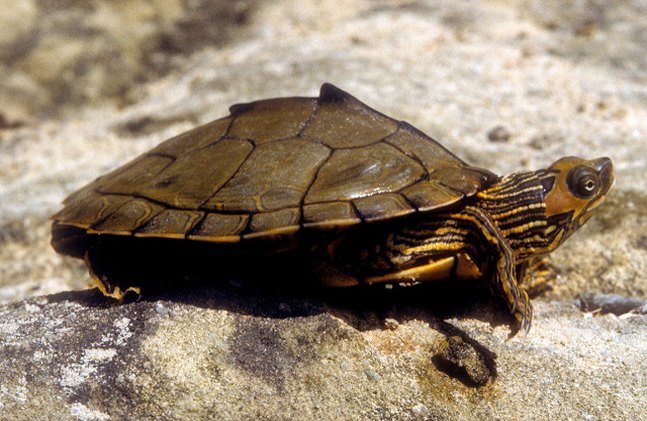
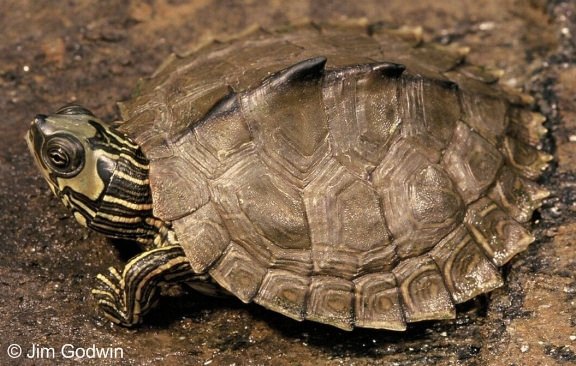
The Alabama Map Turtle is an aquatic breed that could run from medium to large in size. The dorsal keel on the shell helps to easily recognize these turtles, at least while they are young, as the projections will typically wear down as the animal ages.
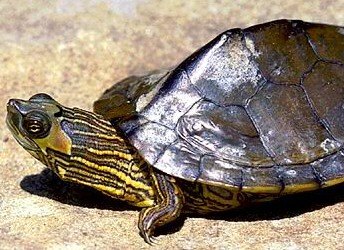
An Alabama Map Turtle’s carapace could sometimes showcase a pattern of orange and yellow colors that could be described as net-like and fine. Also, the olive facial mask features three connected blotches, which is considered a unique feature behind and between the animal’s eyes. You will also notice that a light bar can be seen running from the turtle’s chin to its neck.
Juvenile Alabama Map Turtles will feature a dark stripe that runs down their olive colored carapace, while the plastron will be a light yellow color that has darker coloration along the seams. Each marginal scute will feature yellow lines in a pattern, and the turtle’s interorbital blotch is described as single-pointed.
Adult males, which are smaller than females, will continue to feature the majority of the pattern that is found on young turtles, while adult females will typically become more dull in color, with the potential to lose the majority of the markings that make the males and juveniles so attractive. As adults, these turtles will also feature a broad head, but females have a larger head that could be used to crush mollusks, while males and juveniles feature a strong jaw that is great for eating aquatic insects.
The Alabama Map Turtle is an aquatic breed that could run from medium to large in size.
Colors
Overall, the carapace of an Alabama Map Turtle will be brown, but it could feature some faint green, yellow, or orange markings as well. Juveniles will typically be more colorful, but their coloration will end up fading as they get older. The famous knobbed keel is black and also more pronounced while these turtles are young. Meanwhile, the plastron will be lightly colored and feature five lines that run horizontally so that they outline the turtle’s scutes. Also, the head will be lightly masked, while the legs and neck will be green and feature patterns made up of thin, yellow lines.
Environment
In the wild, Alabama Map Turtles like to spend their time in streams and rivers that feature muddy or sandy bottoms, even though they could also be seen spending time in fast moving creeks that have rocky bottoms. Mimicking this natural habitat in your enclosure will help your pet turtle feel right at home.
It is important to note that a basking site will be necessary for your Alabama Map Turtle. Provide UVB lighting and a heat lamp over your turtle’s basking area and ensure the temperature is set anywhere from the high 80s to low 90s Fahrenheit. Also, use a submersible heater to keep the water temperature anywhere from the low to mid 70s Fahrenheit. Finally, the air temperature could range from the low to mid 80s Fahrenheit.
In terms of water level, the depth should be as deep as possible for your turtle to comfortably swim around. The substrate could be fine to large sized gravel or sand. You could also provide plenty of vegetation.
One adult male Alabama Map Turtle should have an enclosure that is at least 40 gallons or larger, while a single female should have an enclosure that is at least 90 gallons or larger. If you plan on housing more than one turtle in the same enclosure, add 20 gallons of tank space for each male or 50 gallons per female.
These turtles seem to prefer both rocky streams and large, muddy rivers.
Care Requirements
Even though juvenile Alabama Map Turtles will feast on some plants, such as duckweed and other nutritious aquatic plants, this breed is mainly carnivorous. Females prefer meals like mollusks and freshwater aquatic snails. Juveniles and males will enjoy eating mollusks and aquatic snails as well, but because they have smaller and less powerful jaws and heads than their adult female counterparts, they also need access to foods like small fish, worms, tadpoles, aquatic insects, and crawfish.
Behavior
Alabama Map Turtles could be described as shy, and they will often slip into the water as soon as they think there is even just a hint of potential danger. In terms of living with other turtles, you could create a community habitat that consists of other Map Turtles, Cooters, Painted Turtles, and Sliders.
Photo credit: Lord Natonstan/Wikimedia; J. N. Stuart/Flickr; Georgia DNR/Flickr