Alabama Red-Bellied Turtle General Info
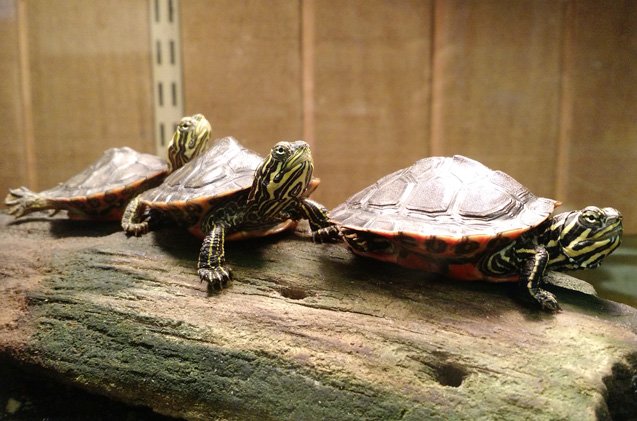
Also known as the Alabama Red-Bellied Cooter, the Alabama Red-Bellied Turtle is popular in the pet trade, and it is also Alabama’s official state reptile. However, because this species is endangered in its natural habitat, it is important to be absolutely sure you are purchasing your pet from a reputable breeder who can guarantee that the animal was born and raised in captivity rather than taken from the wild.
Also known as the Alabama Red-Bellied Cooter, the Alabama Red-Bellied Turtle is popular in the pet trade.
Native Habitat
The Alabama Red-Bellied Turtle is one of three species of red-bellied turtles. Each of these three species are isolated from one another geographically.
The natural range for the Alabama Red-Bellied Turtle is limited to the Mobile-Tensaw River Delta, which is found in Baldwin and Mobile counties in the state of Alabama.
These turtles prefer the shallow backwaters of bays, bayous, rivers, and streams that contain freshwater and plenty of vegetation. They also like bodies of water that have soft bottoms.
The Alabama Red-Bellied Turtle is one of three species of red-bellied turtles.
Overall Description
One of most unique characteristics of the Alabama Red-Bellied Turtle is the obvious notch found at the tip of the animal’s upper jaw, with a tooth-like cusp on either side as well.
Male and female Alabama Red-Bellied Turtles can be distinguished from one another quite easily because the females will be a bit bigger. Also, the males will feature foreclaws that are elongated.
Colors
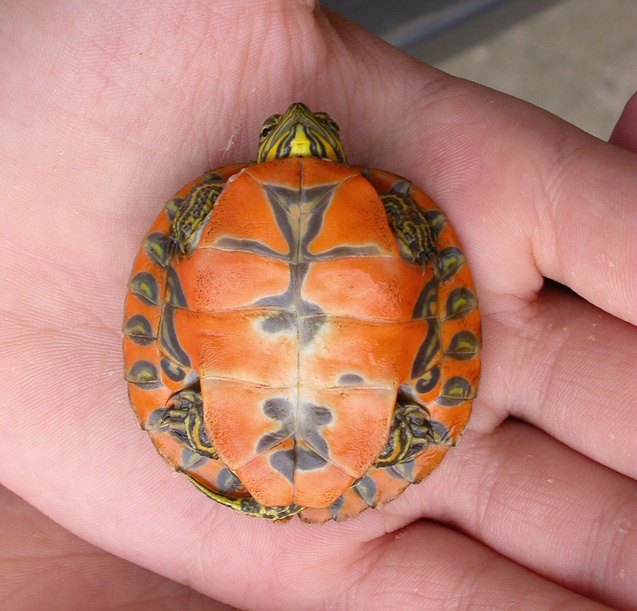
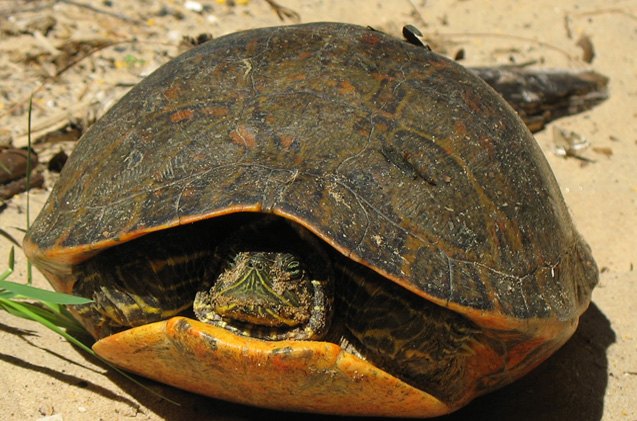
The Alabama Red-Bellied Turtle features a carapace that could be anywhere from black or dark brown to greenish in color. There will also be red, orange, or yellow markings that run vertically along the sides of the turtle’s body. The plastron, on the other hand, may or may not feature dark markings, and it will be anywhere from red to pale yellow in color. Also, this turtle’s legs, neck, and head will have yellow colored stripes as well. Young Alabama Red-Bellied Turtles will usually feature colors and markings that are more intense in appearance.
Environment
Like other cooters, the Alabama Red-Bellied Turtle will benefit from being housed in a backyard pond or an aquarium in which the water will be clean at all times with the help of a high quality filtration system. Because these turtles can grow to be quite large, you will need a big enclosure. The depth of the water should be anywhere from 1-2 feet or more.
These turtles like to bask, so you will need to have a large platform with UV lighting and a heat lamp that will get the basking area up to around 85°F. The water temperature should be around 75°F, so use a water heater if necessary. For substrate, you can use gravel to create a thin layer at the bottom of your pet’s tank. You can add extra gravel in one corner and then place the basking site above the gravel mound you created.
If you are planning on housing your Alabama Red-Bellied Turtle in an outdoor pond, make sure the water temperature does not go up too high in the summer by placing it in an area that will be partially shaded. You will not need to provide a UV light, as your pet will receive the rays from the sun.
A fenced plastic-lined pond will ensure predators are kept out and your turtle will not be able to escape, and a good size for an in-ground pond would be around 5’x5’ or more if you are housing a pair of these turtles. You can line the edges of the pond with smooth rocks that can be used for basking. You can also include non-toxic aquatic plants like water lilies that your turtle can eat.
You can house your Alabama Red-Bellied Turtle with similar species.
Care Requirements
In the wild, the Alabama Red-Bellied Turtle is herbivorous, so these animals feed on various aquatic plants. You can provide a commercial pelleted diet for turtles as a base for good nutrition, but also provide your pet with non-toxic aquatic plants, such as hydrilla, elodea, pickerelweed, lilies, arrowhead, mud plantain, and eelgrass. You can also give your pet leafy greens like romaine.
Behavior
If you wish to set up a community tank with several turtles in one enclosure, you can house your Alabama Red-Bellied Turtle with similar species, such as Red-Eared Sliders, other Red-Bellied Turtles, Yellow-Bellied Sliders, and Rio Grande Cooters. However, when a male and female are housed together, just be sure to watch for any signs that the male is harassing the female too much.
Like other aquatic turtles, you should not expect to handle your Alabama Red-Bellied Turtle unless it is necessary to do so. Instead, you should expect that these animals are more for observing rather than holding.
Photo credit: Timdwilliamson/Wikimedia