Belgian Horse Breed History
The Belgian Horse breed, which is a native of Belgium and is also known as the Brabant Horse, is one of the ancient European breeds that has also contributed to the development of several other equine draft breeds. It is believed that the Flemish “Great Horse” of the medieval era is the predecessor of the Belgian Horse.
This is an old equine breed, but these horses improved considerably after 1880. The first Belgian Horse was brought to the United States in 1866. There, it was accepted well but it was not as popular as the Percheron Horse.
Belgian horses are beloved for their intelligence and willingness to please.
The official studbook for the Belgian Horse was released in the 18th century. Up until the start of the 20th century, there were three types of Belgian horses, and they were known as “The Grey Horse of Nivelles,” “The Colossal Horse of Mehaigne,” and “The Big Horse of Dendre.”
The number of Belgian horses declined after World War II, thanks to industrialization and mechanization, but their numbers have been increasing in modern times, thanks to increased interest in this unique and beautiful breed.
Breed Traits
Belgian horses are beloved for their intelligence, and they are also known for being docile, kind, quiet, and willing to please. They are hard working animals that are loyal, easy to handle, and friendly to their human companions.
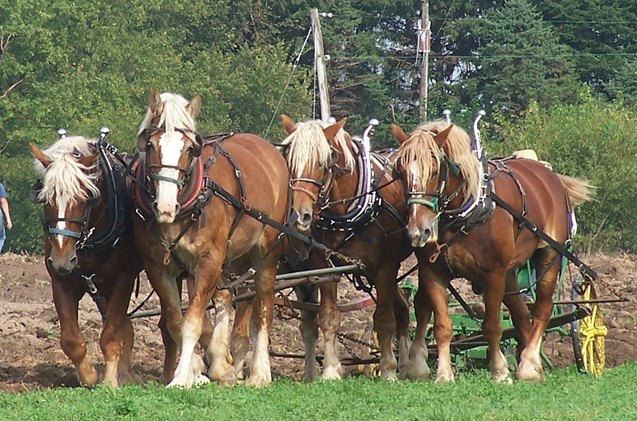
These animals are still often utilized for draft work that includes pulling carriages, sleighs, and hitches, as well as logging and plowing. However, riding draft horses is becoming more popular as well, and these gentle giants are a pleasure to ride for fun.
The Flemish “Great Horse” of the medieval era is the predecessor of the Belgian Horse.
Overall Description
The Belgian Draft Horse has actually held the world record for the largest and tallest horse, and it is the most powerful and strongest of all of the draft equine breeds.
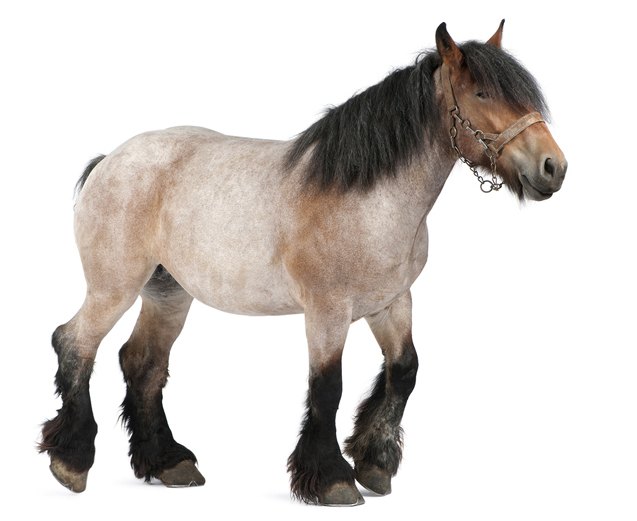
Its head, which features eyes that are kind and intelligent in expression, is described as square and light, and its profile is either slightly concave or straight. Also, its neck is muscular and short, and its body is short and deep. The back is broad and short, and the legs are sound, lean, and strong with medium to heavy feathering.
This horse breed is also known for its heavy body, short legs that are strong, and thick muscles. Overall, the body has a deep girth, but it is short. In fact, this breed is known for being the most compact yet most massive, as well as the lowest set, widest, and deepest, of all of the equine draft breeds.
The Brabant of Europe has been bred to be thick and squat, but American bloodlines of the Belgian Horse are more refined, taller, and almost always chestnut in color with a flaxen tail and mane.
These horses have action that is powerful, although it is less high and springy than that of the Percheron or Clydesdale.
The Belgian Horse is the one of most powerful equine breeds.
Colors
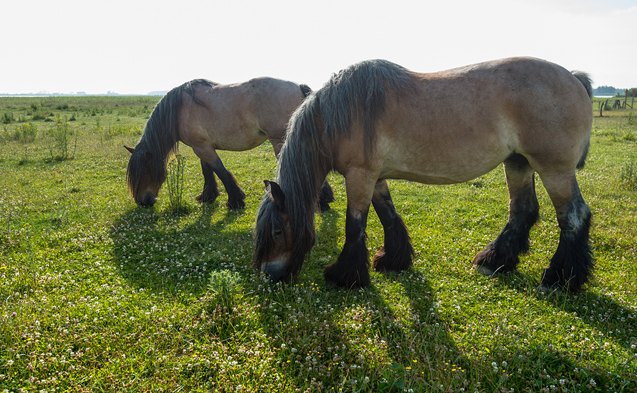
The most common colors of the Belgian Horse are roan, black, bay, and chestnut. However, these horses can also be sorrel with white, as well as dun, red roan, and gray, and they can feature black points.
Despite the various colors that are possible, the Belgian Draft Horse can most often be recognized instantly, thanks to its beautiful sorrel color, white tail and mane, four white stockings or socks, and white facial markings.
Grooming Requirements
As with all other horse breeds, the Belgian Horse needs to be groomed regularly. You should also pay extra attention to the hooves, which should be inspected regularly, as well as cleaned and trimmed on a consistent basis in order to prevent injuries and infections.
Standard grooming tools will be sufficient for the Belgian Horse, though you may need to step on a small ladder in order to reach the top of the horse because of its large size. Also, the feathering on the legs of these horses should not be removed or trimmed.
A curry comb will remove loose hair, as well as dirt and other debris, from your horse’s coat, while a dandy brush can further remove dirt, mud, and loose hair that remains after using the curry comb. Next, a body finishing brush can be utilized on sensitive areas, such as the face and legs, before you move on to using a mane comb to detangle and smooth out the mane and a tail brush to do the same with the tail. A shedding blade can help remove excess hair from the coat, and a hoof pick will effectively get rid of debris and rocks from the hooves to keep them healthy.
Photo credit: Ruud Morijn/Bigstock; Life on White/Bigstock; Kay/Bigstock