Smooth Softshell Turtle General Info
Pet owners who would like to make a unique looking turtle a part of their family should consider the Smooth Softshell Turtle.
These turtles are larger than many other breeds, so you will need to be certain that you have the space for one, and you also need to have the right equipment to keep the water as clean as possible. Also, their care level is considered advanced, so this breed may not be the best choice if you have never had turtles before.
Pet owners who would like to make a unique looking turtle a part of their family should consider the Smooth Softshell Turtle.
Native Habitat
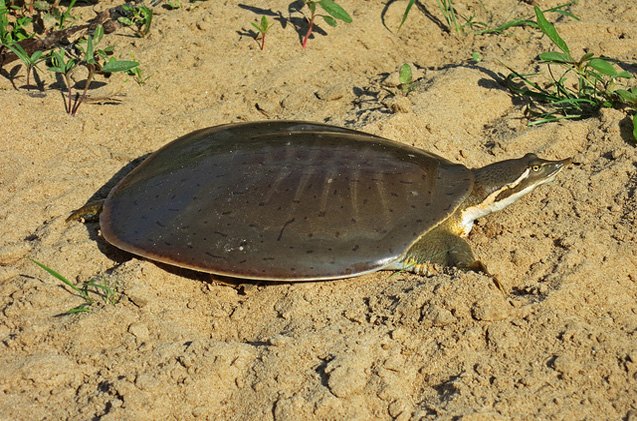
Smooth Softshell Turtles are naturally found in unpolluted bodies of water that include large streams, big lakes, and rivers. These habitats will contain sandy or muddy bottoms, as the turtles do not prefer water that has a rocky bottom. They will end up burying themselves in the sand or the mud underwater when they want to be left undisturbed, and they will use the water as a place where they can retreat when they’re threatened. These animals also prefer environments that have sandbars that can be used for basking.
This breed is active particularly from April through the end of October. You can find these turtles in the Mississippi River drainage and its tributaries from Minnesota to Louisiana, as well as North Dakota, South Dakota, and western Pennsylvania. You might also spot them in the river drainages of Oklahoma, Nebraska, Kansas, and Texas.
Overall Description
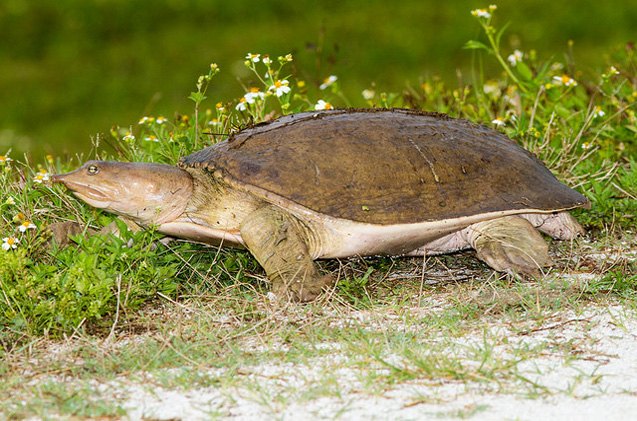
The Smooth Softshell Turtle features a uniquely smooth carapace that does not display any of the typical bony scutes that are found on other turtle breeds. Also, the carapace will be flat and leathery, and the edges will actually be flexible.
When looking at a Smooth Softshell Turtle, you will also note that the nose tapers and comes to a point, and you will not see any ridges within the nostrils.
Females will be larger than males, reaching a length of around 14”. Males will only grow to be about half the size of females.
The Smooth Softshell Turtle features a smooth carapace that does not display any of the typical bony scutes found on other turtle breeds.
Colors
An adult male Smooth Softshell Turtle will be gray or brown in color, and there will also be some small dots and dashes found on the animal’s back. On the other hand, an adult female will feature a carapace that is brown or tan in color, and it will have dark brown blotches that are irregular in shape. Juveniles will look like adults males, with a grayish or brown hue and the scattered and small dark brown dashes or dots.
Despite their differences in color, male and female Smooth Softshell Turtles also feature light colored lines along the sides of the head. One line will be located behind the ear, while another will start below the snout.
Environment
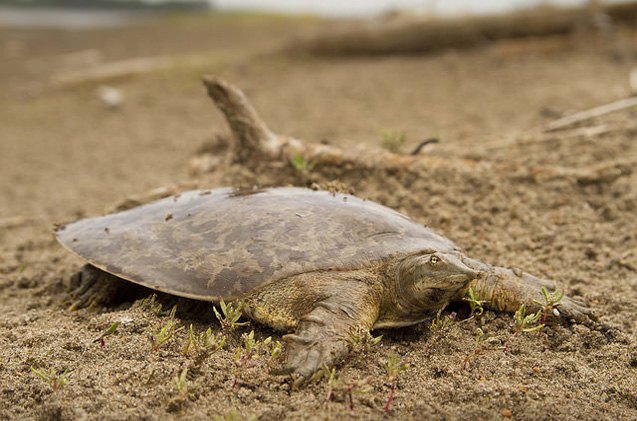
Because a Smooth Softshell Turtle will grow to a medium size, you need to be sure that you will have enough space for your pet once he matures. If you can’t provide a Smooth Softshell Turtle with the proper space, there are smaller breeds that you can consider.
The key to your Smooth Softshell Turtle’s health will lie in the maintenance of clean, filtered water. These are freshwater turtles that spend most of their time in the water, so a high quality filtration system should be in place.
Provide your pet turtle with a sandy substrate so that he can hide in it. Your turtle should be able to completely bury himself in the sand. The water should also be shallow enough that he can reach his long neck to breathe at the surface.
A basking site will be necessary in your turtle’s enclosure. Place it at a slant so that it can dip into the water and your pet can easily come out. You can even make a basking area from a plastic egg crate. In this way, your turtle can come out of the water completely, or he can partially bask while the rest of his body remains under the water. Place a warming light over the basking area so that it can reach 90°F.
The tank should be lit with a multi-spectrum light bulb, the water temperature should be 70-80°F, and the air temperature should be around 75-85°F.
The Smooth Softshell Turtle could get hurt when housed with other turtle species, so it is best to keep this breed on its own.
Care Requirements
Smooth Softshell Turtles are primarily carnivorous, so they will eat just about every aquatic creature that they can get into their mouths comfortably. Their wild diet includes small fish, as well as aquatic plants and aquatic insects, so you can mimic this diet in captivity as well. You can give your turtle a commercial pellet diet as a foundation, and then give him some non-toxic plants and insects as well.
Behavior
The Smooth Softshell Turtle could get hurt when housed with other turtle species, so it is best to keep this breed on its own.
It is important to know that your Smooth Softshell Turtle will be a strong and fast swimmer. If you pick up your turtle, you should expect that your pet will use that power to try to scratch and bite you, so you need to limit the handling of these turtles to those times when it is really necessary. Also, when you handle these turtles, you should do so with extra care, keeping the pet away from your body and making sure that the animal’s face is pointing away from your fingers.
Photo credit: Sam Stukel/Flickr; Peter Paplanus/Flickr; Dan Irizarry/Flickr