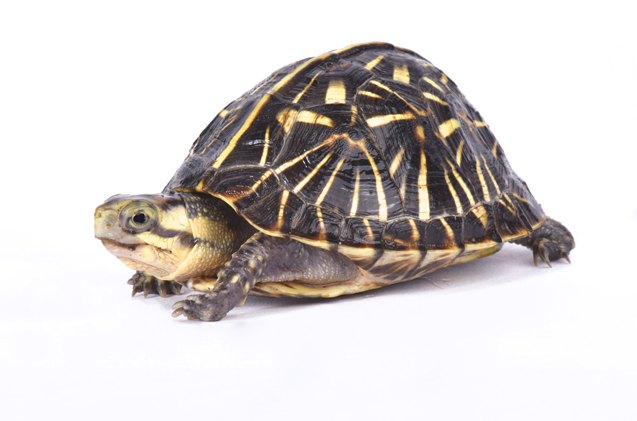
Florida Box Turtle General Info
The Florida Box Turtle is an attractive breed, but these animals are high-maintenance, so they aren’t the best idea for those who are beginners at turtle care.
The Florida Box Turtle is an attractive breed, but these animals are high-maintenance.
Native Habitat
Florida Box Turtles spend their time in marshes, scrub areas, and forest. They are primarily found in Florida and the Florida Keys, but they could also be seen in the most southern parts of Georgia.
Overall Description
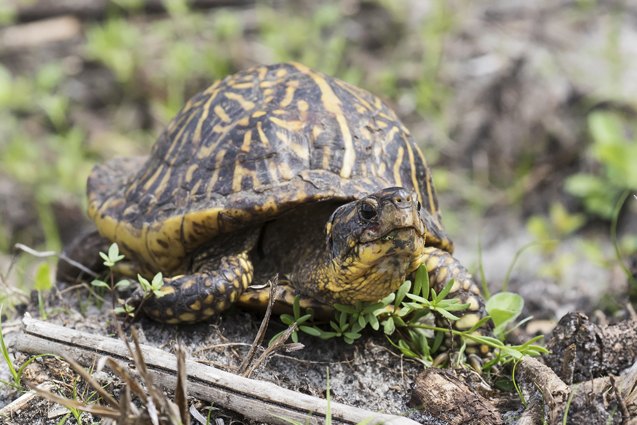
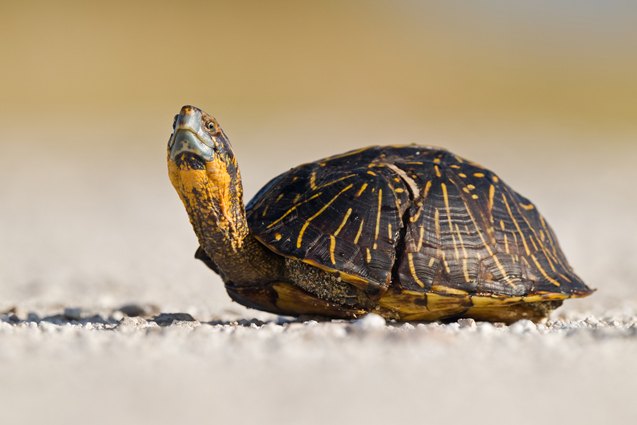
The Florida Box Turtle features a shell that is highly domed, and it also has a hinge so that this turtle could enclose itself completely in its shell. You will also notice that the back of the shell slightly flares outward as well.
Florida Box Turtles often feature four toes on their back feet. And, thanks to their sharp claws, these little turtles are also great climbers, which makes properly securing your pet’s enclosure necessary.
Females will showcase brown or dark red eyes, and their plastron will typically be flatter than that of males. Male Florida Box Turtles, on the other hand, will have eyes that are orange or bright red. Their tail will also typically be longer and thicker compared to females, and their back feet will feature a hooked claw.
Florida Box Turtles often feature four toes on their back feet.
Colors
In terms of coloration, the Florida Box Turtle looks similar to the Western Ornate Box Turtle; however, this breed features more yellow markings that are also thinner. The shell itself is black, and there are also thick yellow lines on both sides of the turtle’s head.
Environment
Even though you could house a Florida Box Turtle indoors, the best type of habitat for this breed is one that is set up outside. This should be a secure enclosure to help keep your pet safe, and it should be in an area that will get sunlight for part of the day, as well as provide shaded spots throughout the day. An enclosure that is made of cinder blocks or wood and is around 4’ by 8’ could house up to four adults. Using fencing is recommended, and ensuring that your turtle can’t see through to the outside of the enclosure will prevent it from constantly trying to escape. Also, using an underground barrier will help prevent your turtle from digging and getting out.
The humidity in your Florida Box Turtle’s enclosure should always be anywhere from 70-90%. To maintain this high humidity level, you could spray the animal’s enclosure at least a couple of times each day, as well as whenever it is necessary to do so. On top of that, you will also need to provide your pet with a substrate that is moist and deep enough for your turtle to be able to burrow into it. And be sure to provide a variety of hiding spots, along with a large, shallow dish that could be filled with clean water (your turtle should be able to climb into and out of this water dish easily as well, as Florida Box Turtles enjoy soaking in water). If you have several turtles in the same enclosure, there should be multiple water dishes to accommodate all of them, or you should have a water area that’s big enough for all of them.
Within the enclosure, you could also use grass clippings and fallen leaves to create a compost area that could attract invertebrates and insects that your turtle could hunt down. This compost area could also double as a hiding spot.
Care Requirements
The Florida Box Turtle enjoys eating a variety of invertebrates, as well as plants and insects, along with a commercial food for turtles. You could feed your pet wax worms, mealworms, silkworms, earthworms, and crickets, but your turtle could also consume slugs, flies, spiders, and beetles. Dusting your turtle’s food with a high quality vitamin powder and calcium supplement is also recommended.
When it comes to vegetables, your Florida Box Turtle might enjoy turnip greens, mustard greens, and dandelion greens, as well as yellow squash, sweet potatoes, and grated carrots. Various fruits could also be offered as treats, and they could include blackberries, cantaloupe, raspberries, strawberries, papaya, bananas, and honeydew melon. And your turtle might even enjoy feasting on mushrooms and moss too.
Behavior
Overall, these turtles make good pets for experienced owners because they typically do not bite, they are small, and they are fun to observe, but they are not fond of being handled. And, even though the Florida Box Turtle does not require a companion, if you wish to keep more than one of these turtles in the same enclosure, you could do so, provided that there is enough space and there are at least two females to every one male because males will aggressively harass females in order to breed.
Photo credit: reptiles4all/Shutterstock.com; Brian Lasenby/Shutterstock.com; Peter Schwarz/Shutterstock.com