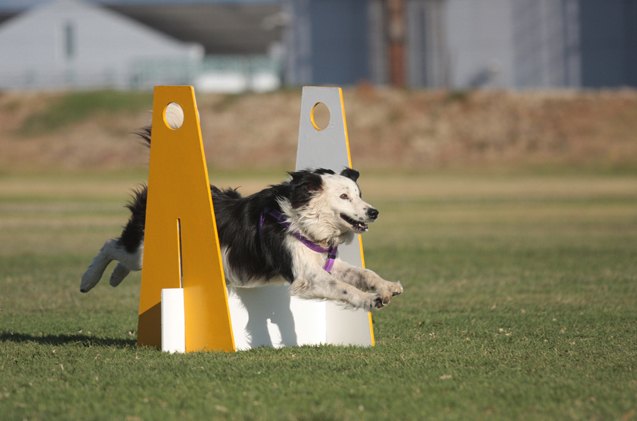
Looking for something fun and challenging to do with your active dog? Why not give flyball a go!
Dogs have an inherent love for chasing and retrieving balls – they will never turn down a game of fetch. If your dog loves to fetch and you are looking for a fun activity to engage him in, consider training him for flyball. Flyball is a great way to engage with your dog, to enhance his training and to give him something fun to do. In this article you will learn the basics about what flyball is and how to get your dog started in flyball training.
What is Flyball?
Flyball is more than just a big game of fetch – it is an organized obstacle course-style relay in which dogs compete in teams for the fastest time. The course begins with a series of four obstacles that the dog must navigate in order to reach a box. When the box is reached, it hurls a tennis ball into the air which the dog must retrieve and then race back over the hurdles to the starting line. When the first dog reaches the starting line, the next dog on the team begins and the process repeats until all of the dogs on the team have completed the course. The team with the fastest time wins, so training is very important to ensure that your dog has a good performance.
Steps for Training
1.) If you are starting completely from the beginning with your dog’s flyball training you will want to first train him to retrieve a tennis ball – the catch is to train him not to drop it until you give the command. Start by engaging your dog in brief 10 to 15-minute sessions of fetch per day. When the dog brings the ball back to you, give him the “release” or “drop it” command and give him a treat when he responds correctly.
2.) The next step in training your dog for flyball is to teach him to jump over hurdles – there are four hurdles on a flyball course which your dog will have to jump in order to retrieve the ball. Set up a single hurdle in a flat area of your yard and stand in front of it with your dog. To get your dog to jump the hurdle, throw the tennis ball over it and give your dog verbal encouragement to retrieve it – if you have taught your dog a “fetch” command, this is the time to use it. Practice this for 10 to 15 minutes a few times a day until your dog consistently jumps the hurdle to fetch the ball and brings it back to you.
3.) Next, set up a second hurdle about 5 feet away from the first the toss the tennis ball over both of them for your dog to fetch. You may need to walk your dog over the hurdles the first few times until he gets the hang of it. Again, reward your dog with a treat when he performs the task correctly. Once your dog gets the hang of the two hurdles you can add a third and eventually a fourth until your dog is running through a mini flyball course.
4.) Once your dog has the hang of the hurdles you need to introduce him to the flyball box – the box that hurls the ball into the hair when your dog reaches it. Your first step will be to train the dog to press on the box so it will release the ball. Each time your dog presses the box correctly to release the ball, give him a treat to reward him. Continue to work with your dog in 10- to 15-minute sessions, giving him the command to go to the box from increasing distances so that he has to run to the box and press it.
5.)Now that your dog has mastered all of the individual elements of the flyball course, it is time to put them together. Set up the first hurdle six feet from the starting point and the rest of them 10 feet apart with the flyball box fifteen feet past the final hurdle. Start with the dog at your side and release him to run over the hurdles to press the box and release the ball. When he catches the ball, give him the “come” command so he will jump over the hurdles and return to you.
Teaching your dog to complete a flyball course will take time and a lot of patience. As long as you are consistent in your methods and in rewarding your dog for proper behavior, however, you shouldn’t have any trouble. Once you have your dog running the whole course, go through it with him for 15-minute sessions twice a day for several weeks until he performs the task consistently well.