Western Painted Turtle General Info
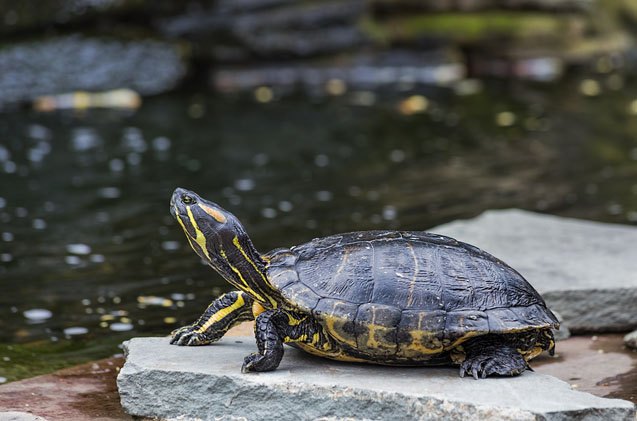
One of the most popular pet turtle breeds, and one that is appropriate for beginner turtle keepers, the Western Painted Turtle is the largest of the four Painted Turtle species. There are many captive-bred Western Painted Turtles, and these attractive, colorful turtles are a joy to watch as they swim and bask.
The Western Painted Turtle is appropriate for beginner turtle keepers.
Native Habitat
Painted Turtles can be found all over the United States, from east to west. They can also be found all the way down to northern Mexico and up to the southern part of Canada.
Western Painted Turtles, in particular, can be found in New Mexico, Oklahoma, Colorado, Idaho, Wyoming, Michigan, North Dakota, South Dakota, Washington, Oregon, Arizona, Indiana, Kansas, Missouri, and Wisconsin, as well as British Columbia, across southern Canada, and western Ontario.
You will find these turtles near rivers, lakes, and streams, as well as wetland habitats that are located near bodies of water.
Overall Description
When compared to Sliders, the Western Painted Turtle is similar in both form and size. You will notice that the carapace has no keel, and it is oval, flattened, and smooth. Also, the posterior rim isn’t serrated, and the vertebral scutes of the Western Painted Turtle are broad.
The Western Painted Turtle also features a plastron that isn’t hinged, and the head will be moderate in size with a snout that projects slightly. You will even note that the upper jaw features a terminal notch that has a cusp on either side.
These attractive, colorful turtles are a joy to watch as they swim and bask.
Colors
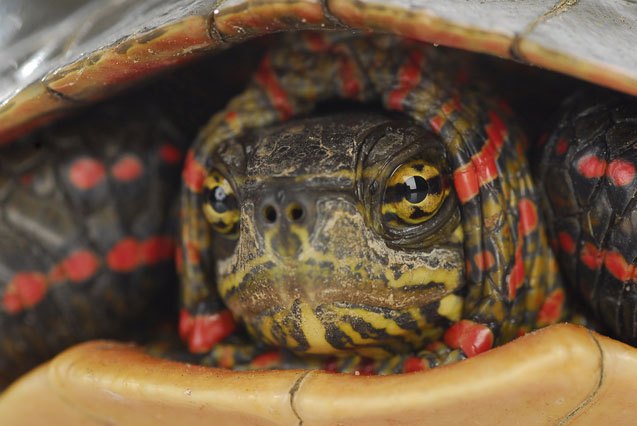
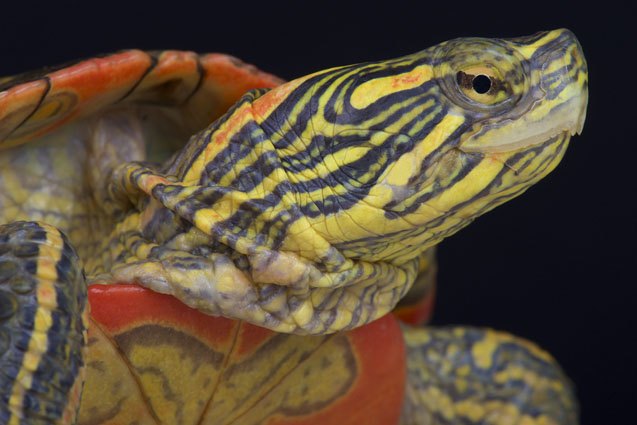
The Western Painted Turtle features a carapace that is olive or green to black in color, and it can be mildly or moderately patterned. Along its seams, there are red or yellow borders, and there are red crescents or bars on the turtle’s marginal scutes. There will also be a medial stripe that could be red or yellow, though this is not always apparent.
The plastron features a beautiful pattern of color. The skin will be black to olive in color, and there will also be yellow and red stripes found along the tail, legs, and neck. The yellow stripes on the head include a yellow line that extends from underneath the turtle’s eye and may connect with a stripe from the lower jaw. You will also see a big yellow streak behind each eye, and the chin has a couple of wide yellow lines that will come together at the tip of the turtle’s jaw.
Environment
Western Painted Turtles can be housed indoors or outside in a garden pond that is safe and enclosed.
Like other Painted Turtles, the Western Painted Turtle likes to spend a lot of time basking, so you need to set up a good basking spot for your pet. This should include a non-abrasive platform on which your turtle can completely dry off, along with a heat lamp that will ensure the basking area remains anywhere from 85-90°F. These turtles will also require a UVB lamp over their enclosure. The rest of the air temperature in the enclosure should be anywhere from the low to mid 80s Fahrenheit.
The water should be filtered and pure at all times, and a water heater will ensure that the water temperature remains anywhere from the low to mid 70s Fahrenheit. Keep in mind that these turtles are avid swimmers, so they should be able to dive down into the water and swim around easily.
Tank substrates are optional for these turtles, so you can keep the bottom of the tank bare or you can opt to get river rock, gravel, or sand. Just make sure that the substrate is either small enough to easily pass through your turtle’s digestive tract if it is swallowed, or too big to swallow in the first place.
Provide your turtle with underwater hiding places, but make sure that they are safe, as you don’t want your pet to get stuck and drown.
A single adult male Western Painted Turtle can be housed in a 75-gallon tank, as a minimum, while females would need at least a 125-gallon enclosure. The enclosure would need to be even bigger if you are going to house multiple turtles in the same tank.
Western Painted Turtles do well when they are not handled often.
Care Requirements
Western Painted Turtles can be fed a commercial turtle diet, along with fish, shrimp, and non-toxic aquatic plants like water hyacinth, water lettuce, pondweed, water lilies, duckweed, water fern, hornwort, and frogbit, as a few examples.
You can also provide your pet with vegetables, such as collard greens, endive, red leaf lettuce, escarole, dandelions, mustard greens, kale, romaine, beet leaves, squash, and zucchini. These turtles will also enjoy crickets, fruit, and worms, such as bloodworms and mealworms.
Behavior
Western Painted Turtles do well when they are not handled often, so only pick up and hold your turtle whenever it is necessary to do so. They can become stressed if they are handled too much, and they can bite or scratch if they are frightened or provoked.
These turtles do well in community tanks with other Painted Turtles, as well as similar species of comparable size. Make sure you give them plenty of space and hiding places, and watch out for aggressive behaviors.
Photo credit: Matthijs Kuijpers/Bigstock; sbonk /Bigstock; Willee Cole/Bigstock