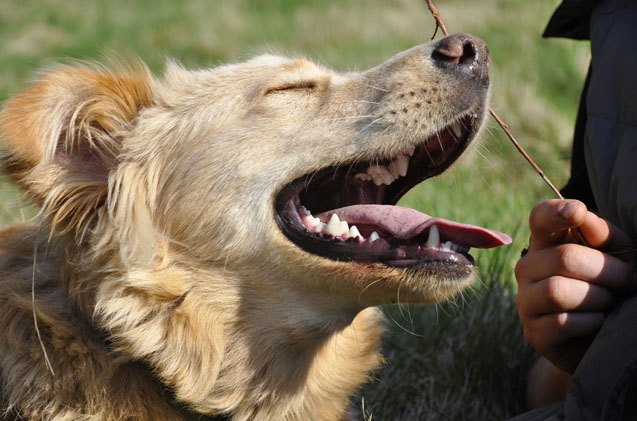
Naked feelings of love, fairness and jealousy of our loyal companions
Any long-time dog lover will be able tell you that their dog has feelings. But is there any scientific proof that canines can actually feel just as we humans do? The simple answer is yes, but since the concept of “emotion” is so broad, we’ll need to dig a little deeper.
Canines can indeed feel certain emotions, but not to the same extent that we do. It’s been proven how canine brain is extremely similar to a human brain; however, as it stands right now, their feelings aren’t connected to any memories or complex thoughts like ours are. In addition, dogs don’t have any conscious control over their thought process. Dogs can’t lie to us, and they don’t experience any sort of reservations or hidden agendas. The emotions that dogs express are honest and pure, or in other words – instinctive.
Progress in studies of canine brain
1
2
Normally, pets would be put under anesthesia in order to undergo an MRI, but the problem is that researchers are not able to study brain functions properly when the animal is sleeping. Professor Berns, on the other hand, trained his dog to place their head into an MRI simulator and sit completely still for 30 seconds. After months of training, he was able to get his female pooch to sit still in the real MRI scanner where he finally got his first brain activity maps. Berns then went on to train and study numerous other dogs with huge success.
Science proves that dogs have feelings similar to us
3
4
5
6
7
What does this mean?
So, shouldn’t all of this research prove that canines must experience the same emotions that we do? Not quite so, unfortunately.
We can’t just assume that dogs have the same emotional range as us. First of all, not even all humans have the full range of emotions at all times. Infants and young children, for example, have a much more limited emotional range than teenagers and adults. This is important because it has been estimated that dogs have roughly the same mental capabilities and level of intelligence as a child between 2 and 3 years old, according to Stanley Coren, PhD. And just like young children, dogs can understand a lot of what you say, but far from everything. They can learn to perform simple tasks, and they can experience some emotions, but not as many as a grown adult.
Because of their lower level of intelligence, dogs don’t have the capability to create lies or scheme up ways to fulfil their hidden agendas. Emotions in canines are raw and real. If your pet is willing to play with you, he is honestly having a good time; but whenever they don’t feel like it, you can forget about the game of fetch – your dog won’t care about sugarcoating his emotions. Leaving ego and drama outside of the relationship is quite liberating and something people can learn from their inferiors. With that in mind, logic leads us to believe that there’s still a boatload of emotions and feelings that canines won’t be able to connect with.
What feelings dogs do experience then?
It isn’t difficult to recognize emotions that your dog is experiencing, some of which can be told by tail wagging. Long time dog owners have been correct in their assumptions on a majority of hypothesis after observing their pets on a daily basis.
Dogs experience the most basic emotions that are not tied to any greater thought. Stanley Coren, a neuropsychological researcher and psychology professor, went through all the available studies and concluded that canines experience the following:
Those feelings that are more complex which people learn as they go through life, including contempt, shame, pride, and guilt, have never touched a dog’s pure mind. Although some dog owners will argue that their dog has clearly expressed at least one of these complicated emotions, this simply isn’t the case. From what we see in a canine’s brain today, it wouldn’t be possible, because dogs operate on a much more basic level than we do.
Let’s take the emotion of “guilt” as an example. Typical scenario: you get home and find torn up bits of your favorite slippers. By this time, your pooch is greeting you at the door with in a semi-excited state and his tail tucked between his legs, in a cowering stance. Even though it seems like your dog is feeling guilty or is ashamed of what he has done, your pet is actually feeling the most basic emotion – fear. Dogs never feel guilty, but they do feel scared of their owners.
Conclusions, and what’s next on the agenda
One of the major questions that researchers are trying to answer right now is whether or not dogs can actually experience the emotion of empathy. As pet owners, we all understand how amazing it would be if our dogs could tell for sure when we’re sad or upset, and would be there for us to try and console. As previously mentioned, some links to this have already been discovered, but more research is needed before we can draw conclusions here.
At present, scientists believe that dogs cannot feel or express complex emotions, as well as clearly read those emotions expressed by humans. They believe that dogs can “feel” our emotions as energy radiating from us, but the feeling only applies to the most generic “positive” or “negative” emotions and nothing beyond that point.
There are multiple theories on dogs following their own set of instinctive rules in everyday life. Remember the time when your pooch was snuggling with you after you had just broken up with your significant other? At that point, what your dog felt was a type of negative energy that you were expressing, therefore, he or she was attempting to “cheer you up.” Dogs will also feel the exact same negative energy after you failed an exam or if one of your close siblings has passed away. Likewise, when you get a raise at work and come home in a great mood, your dog will sense that and share the feeling of excitement, but they won’t be able to actually differentiate between feelings of happiness, extreme excitement or the most mundane joy. It’s just positive energy that they’re picking up on.
8
Dogs’ expression of emotions is like a case of extraterrestrial – you have to see it in order to believe it, but every dog lover out there knows their pet is capable of significantly more than our scientists can currently grasp. As we learn more about our loyal companions, we begin to understand that they are a lot closer to humans – with more complex minds – than we could’ve imagined just a decade ago. At this point, with all this research being done to better understand animals, we may end up finding a way to have actual conversations with them in the future! Wouldn’t it be funny to read this article after that becomes a norm?

Dean Cassady is a writer, entrepreneur and high priest of the scientific method. Being a colossal dog lover coming from the fitness nutrition background, Dean is working alongside his blue-tongued dirt-seeker Aira to provide veterinary cynology information for the benefit of a healthier canine population. He’s also plugging away on something related and unknown that’ll come out sometime between now and infinity.