Why do cats like boxes? We’re about to let the cat out of the box! Here are a few reasons why cats love to hide out in these fortresses of solitude.
If you’ve ever left an empty box lying around the house, you may have turned around to find your cat having a great time inside it. And let’s not fail to mention the many cat videos online that feature frisky felines playing inside boxes.
Whether you own cats or not, you’re probably already aware of the fact that they love boxes. But why do cats like boxes and similar objects so much?
Instincts Toward Safety and Security
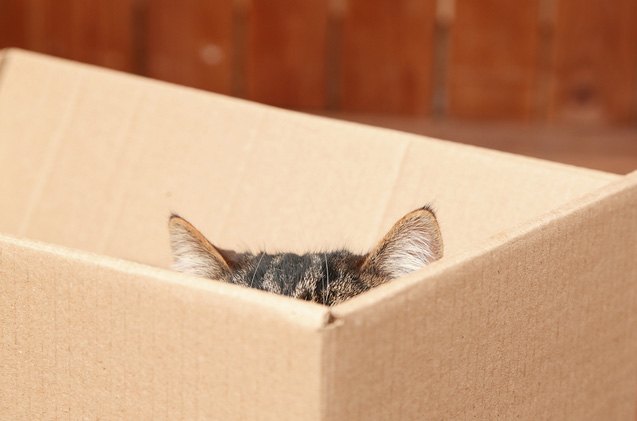
Boxes are confined spaces that appear safe to cats on an instinctual level. The same types of spaces in the wild would be attractive to a cat who’s trying to get away from a predator or who’s trying his best to hunt his prey without being seen.
Related:Cat Library A Novel Approach To The Mewey Decimal System
In addition to being able to hide and feel safe and secure, sitting inside of a box is a great way to avoid becoming prey because a predator is unable to sneak up behind a cat and take him by surprise. Plus, the sides of the box prevent sneak attacks from those directions as well. If any other animal wanted to get the cat, he’d have to approach from the front, which means the cat would be able to see him and either fight back or try to get away.
While sitting in a box, a cat can also comfortably watch the world without being seen. If something of interest passes by, whether it’s a prey animal in the wild or a fun toy in someone’s home, the cat can jump out at a moment’s notice before quickly retreating back to his safe spot.
Tip: Set up boxes in areas of your home where your kitty can enjoy some playtime with you. Perhaps get a toy on a string or a feather toy and move it around in front of the box to give your pet a pleasant surprise and entice him to play. He might try reaching out and grabbing the toy or he might run out of the box to chase the toy down. This can be a fun way to encourage your pet to exercise, and it’s sure to be amusing for you to watch his antics as he gets excited by the sudden “prey” that has appeared outside of the box.
An Ideal Place to Sleep and Stay Warm
Considering how much cats sleep every day, it’s no surprise that they want to be certain they have a place to rest without having to worry about their safety, and a box is a great option. In addition to protecting a cat from predators and sneak attacks, a box is an ideal spot for a nap because it’s cozy and covered, providing shelter and security.
If a box is quite small, a cat won’t hesitate to climb in, curl up, and relax. And while this may seem uncomfortable to you, it’s actually just right for the cat because this is one way that he can keep warm by preserving body heat. Corrugated cardboard, in particular, happens to be a good insulator, which may explain why your cat especially enjoys climbing into cardboard boxes.
Tip: Rather than just getting a cardboard box and setting it up for your kitty to find, make it comfortable by placing a soft blanket or a small cat bed inside. This can also help your kitty feel even warmer when he decides to use the box to settle down for a rejuvenating nap.
Related:Cats Break The Internet With Kittenish – A Book Of Naked Selfies!
Stress Reduction
Having a box to hide in can actually help a cat reduce his stress levels. For example, if you bring a new kitty home for the first time, providing him with a box to hide in could reduce his anxiety and help him get used to his new home more quickly.
The initial reaction of most stressed felines is to hide and essentially withdraw until they feel it is safe to come out. When given a place to hide, such as a box, cats might cope with stressors and environmental changes better. Think about wild cats that retreat to caves, dens, and treetops, and then apply that behavior to your pet cat who isn’t much different.
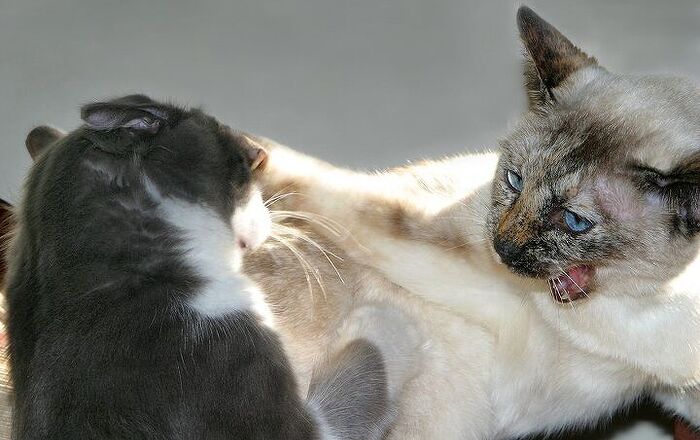
Also, because cats resolve conflicts by basically running away from them and avoiding them, a box is a great place where unwanted attention, hostility, and anxiety can simply go away. Perhaps giving each of your cats their own box might help if there’s conflict you hope to resolve. Each kitty can use their box to avoid confrontations with other pets in the family. Or, if your cat tends to get shy or a bit frazzled around strangers and people he doesn’t know well, he might decide to retreat to his box when you have guests over that make him feel uneasy.
Tip: There are several strategies you can try when you hope to reduce your cat’s stress. Setting up a box is one step you can take. And, as mentioned above, making the box super comfortable and inviting by adding a bed or blanket can certainly be helpful. But you can also go a step further by using things like catnip and feline pheromones, which might help your companion feel more at ease too. Try out different things to see what works best for your one-of-a-kind cat.
Take Advantage of Your Cat’s Love of Boxes
Don’t get annoyed if your kitty has an affinity for boxes. Instead, use it as an opportunity to provide your cat with a really affordable toy that he’ll enjoy. Give it a try: place a towel or a pillow inside his favorite box and place it near a window so he’ll have a quiet, warm, and safe place to sleep. You might find that it becomes one of your kitty’s go-to places in the house.
If you want, you can also get creative by flipping the box upside down and cutting holes along the sides and on the top. When your cat hides inside, you can tempt him with toys that he can try to grab through the holes.
Some handy cat owners have even built kitty condos by attaching cardboard boxes to one another and cutting out holes that allow a cat to travel through his own “fortress of solitude.”
Also, your kitty might want you to set up a box so he can jump into it from the opening at the top or he might prefer it to be placed with the opening on one side so he can easily walk into and out of it whenever he wants. With a little observation, you’ll be able to figure out what your cat wants, and you can then use boxes to enrich his environment and keep him happy.
Boxes: Small, Secure Places That Can Be Loads of Fun
Cats can showcase some habits and preferences that might not make much sense to you at first. When he enthusiastically climbs into a box, you might wonder why he’d want to sit inside such a small space. But, as you get to know your cat better, you may realize that there are some pretty solid and interesting reasons behind his quirky behavior. That simple box isn’t just a place where he can feel secure, it can also be a spot where he can have some fun.
So, the next time your cat is eyeing up a box to jump into, let him. After all, he’s just following his instincts and having a good time. Plus, it’s really cute and you might be able to get some adorable photos of your furbaby!