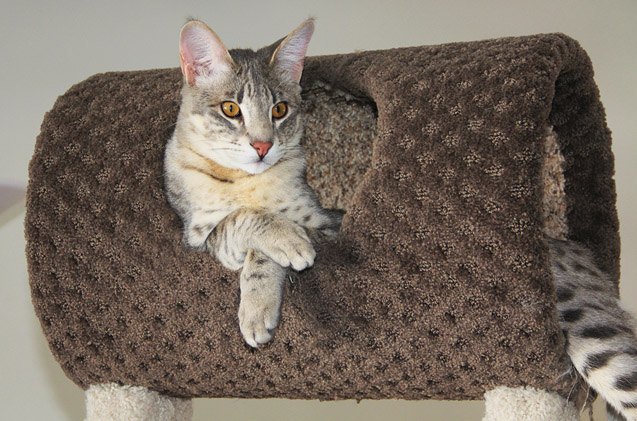
Perching isn’t just for the birds. Have you ever noticed how your kitty loves to climb up cat trees? Let’s look at why cats love an indoor tree with a view!
Indoor kitties who don’t have access to real trees have man-made “cat trees” that they love to climb up and spend time on. Perched high atop their cat tree, they can nap, play, and relax as they watch everything that’s going on.
But why do so many cats enjoy being in high places around your home, looking down upon their domain and surveying everything beneath them? Is it so they can feel more powerful, or is there more to it?
Cats Use Height for Safety
Cats who live outside may choose to climb up trees in order to be able to observe what’s going on around them from a safe place. They may also use a tree to target prey or get away from predators. And your indoor kitty has these same instincts.
Related:Product Review: Hagen Vesper V-Tower Cat Furniture
By climbing high up onto her cat tree, your kitty can perch and check out her surroundings, and she can also get away from other cats in the house. In fact, a cat tree might be a good way to reduce feline conflicts in your home because it gives them a place to escape to.
Shy Felines Feel More Confident
Kitties who are timid could benefit from a cat tree, as they can climb high to check out their environment and easily see what’s going on around them without fear.
Related:Cats Are the Muses Behind WAM’s “Meow: A Cat Inspired Exhibition”
If your cat often hides and avoids coming out into the open, setting up a cat tree with a high perch or hideaway could give her the ideal place to feel secure. You might even find that your cat has no problem spending time with the family when she’s in her cat tree, so she may be less likely to hide under your bed.
More Territory for Your Kitty
Horizontal territory is important to your cat, but a vertical cat tree will provide convenient and desirable vertical territory. This will serve to increase her living area and give her more space.
If you have more than one cat but they don’t necessarily like to spend time together in close spaces, a cat tree could be a great solution. A large tree with multiple levels, hideaways, and perches can easily be shared while giving each cat the space she prefers.
Enrichment for a Happy Feline
Put simply, felines love cat trees because they’re a lot of fun to climb. Kittens and adults like using their bodies to balance and reach high places, and it’s a great form of exercise.
Things to Consider When Shopping for a Cat Tree
When you’re looking for the ideal cat tree for your furry friend, consider her personality and size. Perches should be big enough for your cat to fit comfortably, and you can find cat trees with hanging toys for a playful kitty or hideaways for a timid pet. There are also different types of scratching posts, so consider the surface material that your cat likes best, such as sisal or wood.
It’s also important to think about the location of your cat tree. While you don’t want it to be in the way, you should keep it in a part of your home where your family spends a good amount of time. If you place the cat tree in a room that no one spends time in, it’s more likely that your cat won’t use it. Also, putting the cat tree near a window is a great way to let your kitty see what’s going on outside. Again, keep your pet’s personality in mind to make the right decision.
Even though a lot of cats love their cat trees, just remember that every feline is an individual, so your pet may not feel the need to use a cat tree. For kitties that do enjoy cat trees, though, they’re the perfect alternative to jumping onto your furniture, and they allow cats to have fun, exercise, and feel safe and confident.