Andalusian Horse Breed History
The Andalusian Horse originally came from the Iberian Peninsula, and it is named after the Province of Andalucia, which is the part of the world where it is the most famous. It is believed to be an ancient horse breed, as a similar type of horse is depicted in cave drawings that are 20,000 years old, and Homer even mentioned these horses in his work, The Iliad.
In 711 A.D., Andalusian horses were bred with the horses of the Moorish invasion, which were the Spanish Barbs. However, this breed was principally bred by Carthusian Monks during the latter part of the Middle Ages. In fact, the Carthusian Monks were excellent horse trainers and breeders, and they were able to keep the bloodlines pure. Also, Cortes was the one who was responsible for bringing Andalusian horses to America during his conquests.
The Andalusian Horse breed is the foundation for many other breeds.
Though the breed was threatened when Napoleon’s army stole Spain’s horses during an invasion in the 1800s, a herd was hidden and ultimately used to keep the breed alive and pure. And even though an epidemic in 1832 devastated the horse population in Spain, a small herd of the Andalusian horses found at the Monastery of Cartuja survived in order to keep it going.
It is also worth noting that the Andalusian Horse breed is the foundation for many other breeds, including the Lippizzaner and Peruvian Paso. In Spain, where it excels in traditional equestrian pursuits and ranch work, this breed is referred to as Pura Raza Espanola, which translates to Pure Spanish Race. And it was not until 1962 that Andalusian horses were exported.
Breed Traits
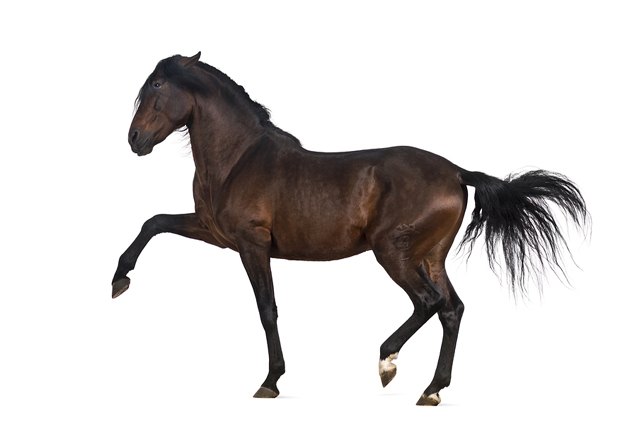
Described as robust yet elegant, the Andalusian horse has a unique ability to bring its haunches far beneath its body in order to elevate its forehead. This trait makes them talented when it comes to upper movements of dressage, including piaffe, airs-above-the-ground, and passage. These horses move with upright steps when they canter and trot, and these steps are also quite distinctive.
These animals are ideal for performing a wide range of tasks as well. These tasks go beyond dressage to also include jumping, general riding, mounted athletics, and various forms of work.
In terms of their personality, Andalusian horses have a wonderful temperament. These animals are smart, as well as sensitive, docile, and brave. The breed has a desire to learn, and these horses can easily adapt to new and changing situations with ease.
Because these horses are responsive, obedient, and cooperative, they are easy to train and quite versatile, and they can also learn quickly. However, some horse experts recommend taking on this breed only if you have experience working with horses because of their agility, heavy build, and quickness.
Andalusian Horses have a wonderful temperament.
Overall Description
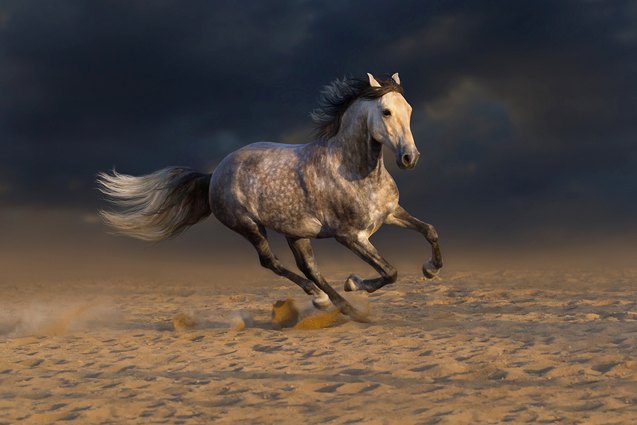
The Andalusian Horse has a unique appearance. Its head is of a medium length, and its face is well proportioned with a slightly convex or a straight profile (concave or convex profiles aren’t desirable).
This horse also features a forehead that is slightly round and wide, a jaw that is lean and full, and a jaw line that is discreetly arched. The nose will gradually narrow and the nostrils are almond shaped, while the eyes are expressive, lively, and somewhat triangular. The ears are small, and the distinctive tail and mane are abundant, long, and wavy.
An Andalusian’s back will be solid and almost straight, as well as muscular and a bit short, while the withers should be subtly wide and the chest should be deep and full with arched, long ribs. The neck is of a medium length and size, and it is also muscular and slightly arched. Even the shoulders are muscular and long, and the hindquarters of this breed are lean, strong, and broad, while the tail is set low.
The Andalusian Horse is easy to train and quite versatile, and it can also learn quickly.
Colors
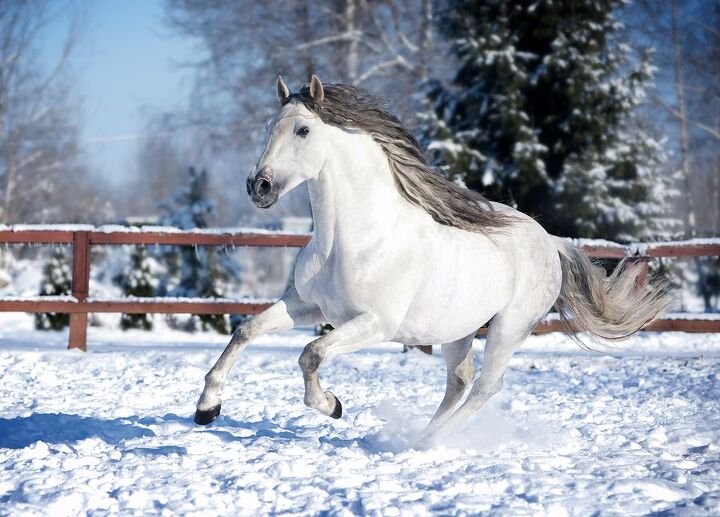
In terms of color, these beautiful horses are typically gray or white. Less commonly, however, they can also be palomino, dun, black, chestnut, bay, and dilute colors.
Grooming Requirements
As is the case with all other horse breeds, the Andalusian breed is one that should be groomed on a regular basis using the standard horse grooming tools that are easy to acquire. These include a hoof pick, tail brush, curry comb, dandy brush, shedding blade, mane comb, and body finishing brush. Using these tools will allow your horse to maintain its beautiful, healthy appearance.
In addition to regular horse grooming requirements, however, the Andalusian breed features a thick mane that is really beautiful but does require a bit of extra work. The same goes for its luxurious, thick tail. You will need to regularly trim and pull the tail and mane in order to keep them healthy. Also, in order to keep the horse’s tail thick and long, you should cut it straight across on the bottom, preferably at the height of the horse’s fetlocks.
Photo credit: Callipso88/Bigstock; i_love_nature/Bigstock; Life on White/Bigstock