Arabian Horse Breed History
It is thought that the Arabian Horse is the oldest horse breed on the planet, as it originated over 4,500 years ago on the Arabian peninsula. In fact, it is believed that these horses were first domesticated from wild horses in the Middle East around 2500 B.C.
The earliest documented breeders of the Arabian Horse were the Bedouin people. They were nomadic tribesmen living in Arabia, and they relied upon their horses to survive. As a result, their horses made wonderful companions, and they would share their tents, water, and food with them. And although the breed was able to thrive in an environment that was quite isolated, these horses have always been known for their sociable nature.
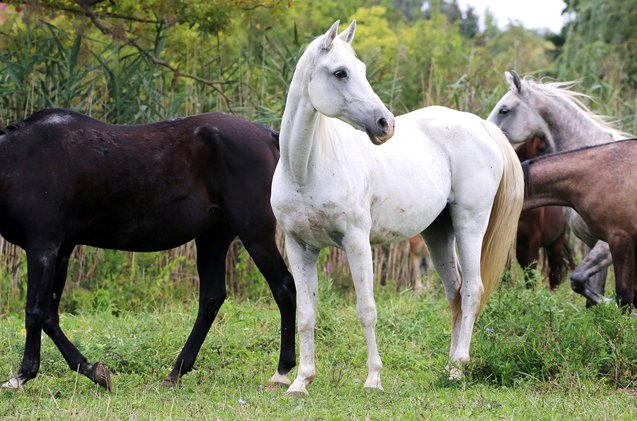
It is thought that the Arabian is the oldest horse breed on the planet.
The Arabian Horse eventually spread into Europe and other regions of the world as a result of religious wars that took place, and European crusaders ended up crossing the Arabian, which was a naturally lighter horse, with their heaver breeds of horses. Throughout the years, the Arabian Horse continued to spread into various parts of the globe as a result of both war and trade, and the breed’s genetic code is now found in nearly every modern riding horse breed.
It was not until 1725 that Arabian horses were imported to America, and a national registry for the Arabian Horse was recognized in 1908. Today, this is one of the most easily recognized horse breeds.
Breed Traits
Because the Arabian Horse spent so much time in close contact with humans, it is a highly sociable breed. If you are seeking a horse that will be eager to please you, this breed will not disappoint.
In addition to being fast, agile, and strong, these horses are intelligent and gentle around their human companions. However, because the Arabian is a hot-blooded horse, this breed is not the best choice for beginners. These animals are best suited to individuals who have experience with equines and with training them.
These horses enjoy speed and athletic activity, and they will learn quickly, thanks to their high intelligence level. Plus, when working with experienced riders, these animals are highly responsive and easy to work with.
Overall, Arabian Horses tend to do much better when they are housed in large paddocks with other horses. Because they are so smart, they can become bored easily, and this could lead to negative habits and behaviors. They also enjoy having objects that they can use to play and keep themselves occupied, and this is a breed that craves interaction, so you must make time for this horse if you choose to care for it.
Arabian Horses enjoy speed and athletic activity, and they will learn quickly.
Overall Description
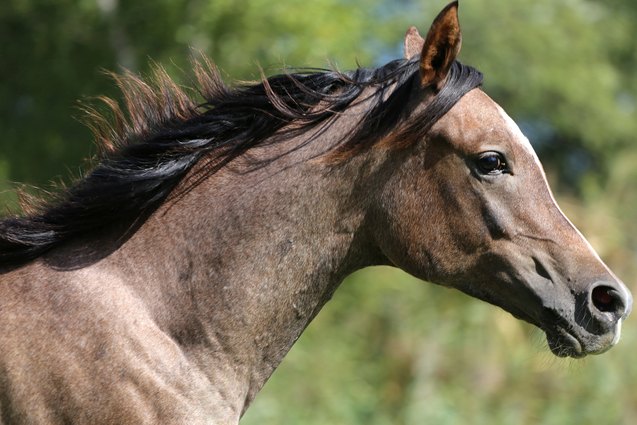
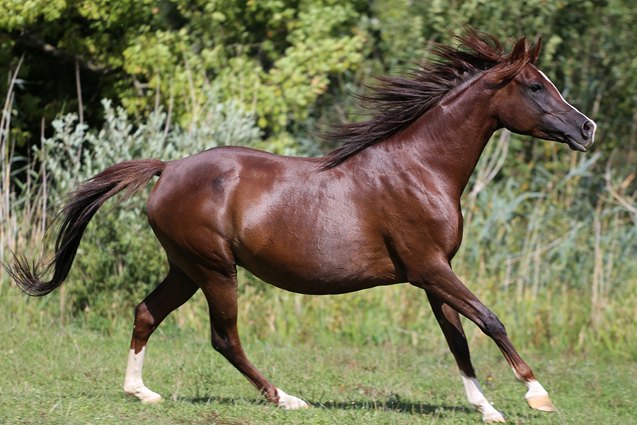
The Arabian breed is truly a beauty to behold, and has quite a few distinct features, such as its dished body, that make it stand out from other horse breeds.
This horse has a small, wedge shaped head, and the profile can be slightly concave or straight. It also has large nostrils and a small muzzle, along with dark, expressive, large eyes that are set wide apart. There is also a short distance between the horse’s muzzle and eyes, and the horse has small ears that are smaller in the stallions than in the mares.
The neck is arched and long, the back is short, and croup is horizontal and long. Also, the tail carriage is high, and the tail is carried straight.
Overall, this horse is well shaped and thin, and it is classified as a smaller breed. Some Arabian horses will have only 17 instead of 18 pairs of ribs, along with only five instead of six lumbar vertebrae.
Arabian horses are built for stamina and endurance, even in the harshest environments. Their balance and strength are the result of their short backs, sound hooves, dense bones, and compact body.
Colors
The Arabian Horse Association states that the Arabian purebred features five beautiful coat colors. They are roan, black, chestnut, gray, and bay, with bay being the most prominent of all of the colors. Purebred Arabian horses can also have a sabino spotting pattern that would feature white markings on the face, belly, or upper legs.
On the other hand, half-Arabians, which are produced by crossing a purebred Arabian with another breed, might have other coat colors. But all Arabian horses, regardless of their coat color, will have black skin everywhere except under white markings, if they have any. The dark skin is what helped to protect these horses from the harsh sun in their desert environment.
Grooming Requirements
In terms of grooming, the Arabian Horse requires regular grooming, just as any other horse breed. This will ensure the coat remains healthy and lustrous. Owners can use standard horse grooming tools, including a body finishing brush, curry comb, shedding blade, and dandy brush for use on the body, along with a mane comb, tail brush, and hoof pick. These can be used to remove dirt, loose hair, and debris from the coat and hooves, as well as keep the tail and mane smooth and clean.