Cagle’s Map Turtle General Info
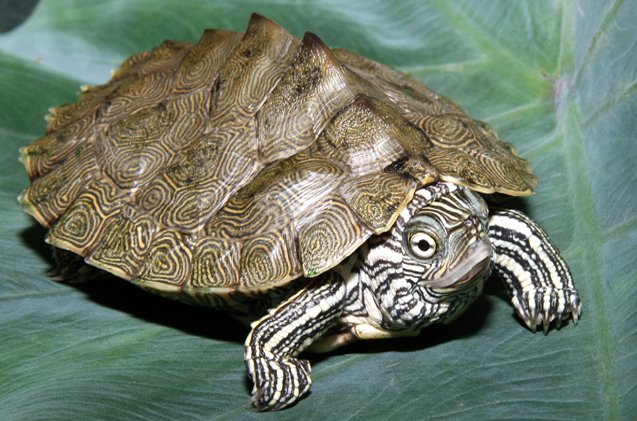
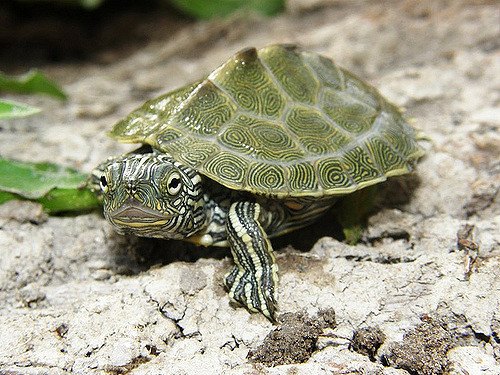
There are several different types of Map Turtles, but they all feature the unique lines that cover the carapace and skin in a pattern that looks like a contour map or a road map. The Cagle’s Map Turtle, which is only found in Texas and is the only Map Turtle that’s mostly green in color, is endangered and rare.
In Texas, these turtles can’t be taken from the wild, possessed, transported, or put up for sale. There are a few private breeders who are located outside of the state who are able to work with the Cagle’s Map Turtle, but this breed is not readily available throughout the United States pet trade. Therefore, it is difficult to obtain one as a pet, and you need to be absolutely certain that you are getting a turtle that has been bred in captivity and has not been removed from its natural habitat.
The Cagle’s Map Turtle, which is only found in Texas and is the only Map Turtle that’s mostly green in color, is endangered and rare.
Native Habitat
Cagle’s Map Turtles have been seen in the Guadalupe River, as well as its tributaries. This breed has also been seen in the Blanco River and the San Marcos River. All of these bodies of water are found in southeastern Texas.
The range for this turtle, however, has diminished, and it now appears that you can only find these animals on a stretch of roughly 75 miles along the Guadalupe River.
These turtles are typically found in limestone streams and mud-bottomed streams that are shallow and have moderate currents. They can also be found in pools that are up to 10 feet deep.
Overall Description
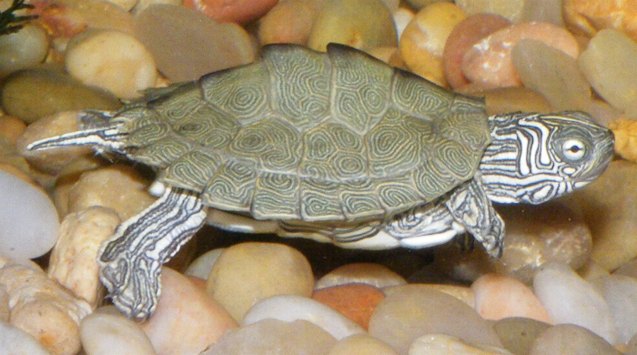
The upper shell of the Cagle’s Map Turtle is serrated only on the back. There are also spine-like, sharp projections that run down the center of the shell. Females will be larger, and will also feature a broader head, than males.
Cagle’s Map Turtles have been seen in the Guadalupe River, as well as its tributaries.
Colors
The Cagle’s Map Turtle features a greenish color overall, but the limbs, tail, and head are black and have several yellow to cream colored lines. There is also a cream colored bar found on the chin, and there is a yellow mark in the shape of a V on the top of the turtle’s head.
The upper shell features a bright pattern of yellow-green and black circles and lines.
Environment
It is recommended that you have a minimum of a 30-gallon tank for one adult male Cagle’s Map Turtle, although 40+ gallons is preferred. The minimum size for a female would be a 40-gallon tank, though 55+ is preferred. You want the tank to be large enough to provide these turtles with plenty of space for swimming. If you are going to have more than one turtle in the same enclosure, you should add at least 20 gallons of space for each turtle.
A high quality filtration system is a must in your turtle’s enclosure. The depth of the water for this breed should at least 6-12”, as these turtles are strong swimmers. Maintaining pure water in the enclosure will help keep your turtle healthy and happy. Also add a water heater to the enclosure to keep the temperature around 74-84°F.
Because this is a breed that loves to bask, you will need to provide your turtle with a UVB light and a heat lamp over a basking area so that it reaches 88-100°F. The rest of the air temperature can be anywhere from the low to mid 80s Fahrenheit.
For substrate, you can use anything from a fine gravel to a large size gravel, or you can use sand. You should also provide plenty of real or artificial vegetation throughout the tank.
If you are planning on housing your Cagle’s Map Turtle outside, you can provide him with an outdoor pond. Just make sure that, because your turtle is an avid basker, he will have a large basking area. You can provide additional basking areas as well. Make sure that the enclosure is large enough to prevent overcrowding if you have more than one turtle. There should be plenty of aquatic plants, including floating plants like water hyacinth, duckweed, and water lettuce. Just remember to bring the turtle inside when temperatures drop to 45-50°F as winter approaches.
If you wish to establish a community tank, Cagle’s Map Turtles will get along well with Cooters, Sliders, Painted Turtles, and other Map Turtles.
Care Requirements
Cagle’s Map Turtles will thrive on a commercial turtle diet, as well as crickets, various insects and worms, snails, aquatic plants, minnows, tadpoles, and leafy green vegetables.
Behavior
If you wish to establish a community tank, the Cagle’s Map Turtle will get along well with Cooters, Sliders, Painted Turtles, and other Map Turtles.
Turtles that have been bred in captivity will be more docile, and you may even be able to feed them by hand. However, like other aquatic turtles, you should only handle your Cagle’s Map Turtle when it’s necessary to do so.
Photo credit: Mokele/Wikimedia; John Williams/Flickr; Bill Hughes/Flickr