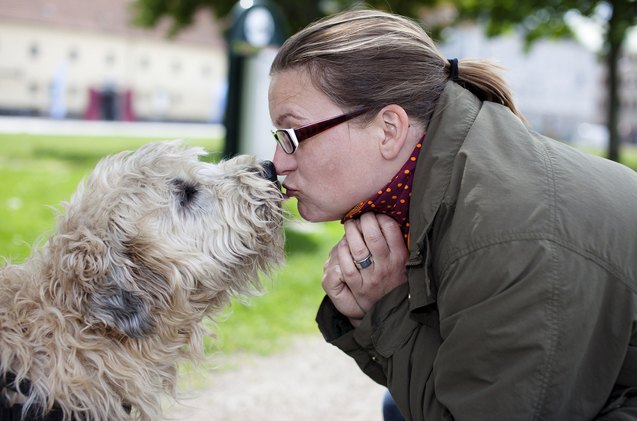
The way pooches spread the love to anyone and everyone at the dog park, it can sometimes seem like our dogs don’t discriminate in their affections; but don’t despair, dear human: scientists say your dog still loves you the most.
Do dogs love people even more than other members of their own species?
That’s the question that Dr. Gregory Berns of Emory University set out to answer with his latest study.
Trust us; it’s not as easy as it sounds. Can you imagine getting a dog to stay still inside an fMRI machine so you can scan its brain responses to different scents? Thankfully, Dr. Berns had done this type of brain imaging study before and had a group of well-trained pooches he could use to help investigate the canine-human bond.
So, just how do you figure out, scientifically, who your dog loves more?
Related:Study Shows Jealousy In Dogs Is Real
The Experiment
Since a dog’s most dominant sense is smell, this is what Dr. Berns and his colleagues focused on.
They used three dog-related scents, one from the dog himself, one from a dog who lived in the same household and one from an unfamiliar dog. They also used two human scents; one from a person the dog was familiar with (like a child or spouse from their human family) and one from a person they didn’t know.
The researchers also paid attention to two special areas in the dog’s brain: the olfactory bulb and the caudate nucleus (yeah, we’re getting all science-y on you — don’t worry, we promise it won’t be that bad!).
The olfactory bulb is the part of the brain that manages scent, while the caudate nucleus is triggered by rewards like food and social interactions; you might call this the “feel good center” of the brain.
Related:Your Dog is Smarter Than You Think
The Results
Dr. Berns and co. found that in terms of the olfactory bulb, there wasn’t a big difference in the way the pooches responded to humans or other dogs. However, they also found an area close by the olfactory bulb, in the cortex, that showed greater activity when presented with a familiar scent. This whole area appears to respond more fervently when the scent is that of another dog. That said, this part of the brain has never been shown to be tied to emotion or feelings, so the increased response likely has more to do with recognizing and identifying the scent of a fellow pooch.
And what about the caudate nucleus, the “feel good center” of the dog’s brain? Well, it paws-itively lit up when the pooches smelled a familiar human. In fact, the caudate nucleus saw more activity when presented with the familiar human scent than any of the other smells. Dr. Berns says this indicates that not only did the dogs recognize the scent of their human, but they likely also have affection for that person, along with the anticipation that spending time with them will be both pleasant and rewarding.
Nature or Nurture?
Does this mean that dogs are now evolutionarily predisposed to caring for all humans over all other dogs? Probably not, says Bern.
Since the dogs showed a diminished response to the scent of the unfamiliar human and a massive response to the scent of the person they knew, we can conclude that affection between dogs and their owners likely comes about because of the way they dog is raised. If it’s a loving and nurturing environment, the dogs will associate the scent of their human(s) with the good things in life, and the “feel good center” of their brain will light up in response.
[Source: Psychology Today]