Dwarf Hotot Breed History/Origin
Contrary to popular belief, the Dwarf Hotot is not a miniature version of the larger Hotot, but was developed by crossing several breeds with the normal-sized Hotot. The original Hotot was developed in France at the beginning of the 20th century by Baroness Bernard. The Dwarf variety was the result of breeding efforts in both East and West Germany in the 1970s. Two breeders independently bred the same rabbit, but came together to cross them. They used both the White Hotot and the Netherland Dwarf to create the Dwarf Hotot.
In 1970, Elizabeth Forstinger of California brought seven Dwarf Hotots from West Germany to the United States and began showing them in 1980. Two years later, the American Dwarf Hotot Rabbit Club was created, and the breed was recognized by the American Rabbit Breeder’s Association (ARBA) in 1983. The Dwarf Hotot is also known as the ‘eyes of the fancy’, a name whose origin is made apparent as soon as you first see these striking bunnies.
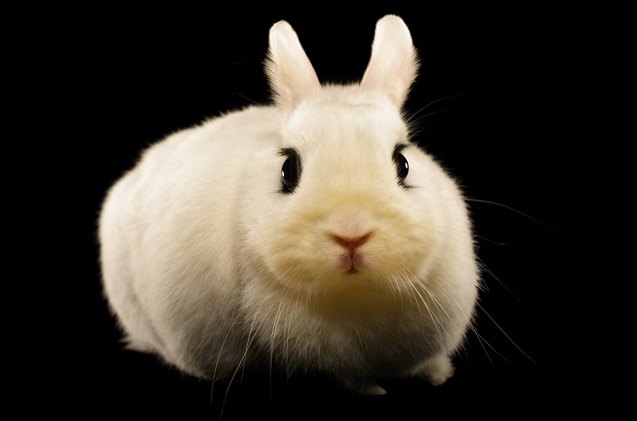
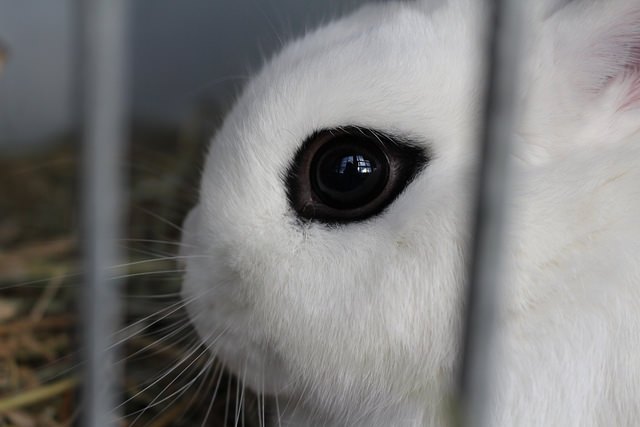
Show-worthy Dwarf Hotots are all white with a ring of black around their eyes that looks like eyeliner.
Overall Description
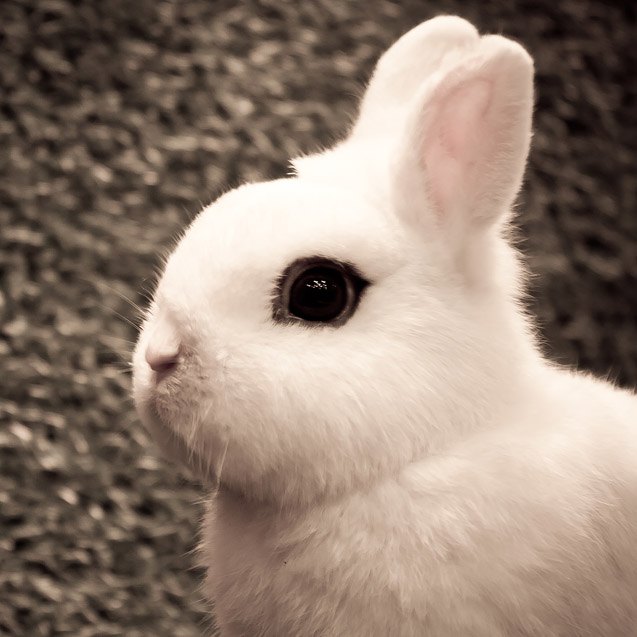
Their hindquarters should be rounded and in line with the wide shoulders. The ears are short and thick. In addition to their adorable looks, these rabbits also have a friendly personality that makes them a good choice for a pet.
Coat
This rabbit breed’s coat is short, dense and shiny. The Dwarf Hotot has so-called rollback fur, which means that their hair stays upright when stroked. These coats do not require much attention, and due to the Dwarf Hotot’s size, you may not even notice when they begin to molt. However, like all rabbits, this breed will also have seasonal molting, usually in the spring.
When this occurs, it’s important to increase the frequency of the brushing- both to prevent loose hair flying around your home and to minimize the amount of it you bunny ingests when self-grooming. Rabbits cannot vomit, so ingesting too much of their own hair can become a serious issue, leading to complications such as intestinal blockage. As a rule of thumb, during the molting season, a good daily brush with a slicker comb will keep everything under control.
Colors
The ARBA accepts one Dwarf Hotot color combination. Show-worthy rabbits are all white with a ring of black around their eyes which almost looks like eyeliner. The black band that circles their eyes shouldn’t be too thin or too thick with a feathered appearance- ideally, it would be a ⅛ of an inch thick.
Naturally, these are requirements for a show quality rabbit and your own pet Dwarf Hotot might not fulfill every requirement. In fact, some Dwarf Hotot don’t even have the pure white coat- Dutch marked or English Spotted kits are not unusual. The only ‘catch’ is that such rabbits cannot be shown for competitions, but otherwise they make lovely pets, same as their show-quality cousins.
The Dwarf Hotot is friendly and suited for life as a pet.
Care Requirements
Due to this rabbit’s small size, it does not require a large cage – a 24 x 24 or 18 x 24 inch cage is sufficient. Usually, these enclosures are made from steel wire, often coated with powder. However, the cage should not have a wire bottom, as stepping on the wire can lead to a painful condition known as sore hocks. Instead, opt for the solid bottom or place a thick layer of rabbit-safe bedding on the bottom to make it soft and comfortable enough for your pet. Bedding needs to be spot-cleaned every day and completely replaced at the end of every week. It is not recommended that this breed be kept as an outdoor rabbit due to its small size.
Naturally, the enclosure you get for your pet shouldn’t be their only habitat. In fact, keeping them in a cage all the time would be cruel. Think of your pet’s enclosure like their own little room where they can sleep and eat (and go potty), but your home should be where they get to spend most of their time. Before you let your Dwarf Hotot out of the cage, though, make sure to bunny-proof the room. Hide all cables, protect furniture and remove potentially toxic plants and foods that could poison your pet.
The Dwarf Hotot will eat as much as much food as you give it, and although hay should be given in unlimited quantities, rabbits of this size only require a quarter cup of rabbit pellets per day. Their diet should consist of 70 percent hay, a quarter cup of pellets per day, and the rest should be a balance of rabbit-safe leafy greens, fruits and vegetables.
Health
Like most dwarf breeds, the Dwarf Hotot is susceptible to malocclusion, a condition where the front teeth are directly above the lower teeth rather than in front of them. When rabbits have this condition, they may accidentally pull a tooth on its cage or have difficulties eating. This can be every 6-8 weeks so they can shorten their teeth. In addition, you should have your vet regularly deworm your rabbit and make sure they have rabbit-safe flea prevention treatment.
With all bunnies, but especially those of this size, vigilance is what makes sure they get to live long and healthy lives. While there are not generally many diseases that target indoor-only, pet bunnies, there are many conditions that could lead to serious problems if not noticed on time. One those is snuffles, an upper respiratory tract infection that commonly affects all rabbit breeds. Runny eyes and nose, head tilting are just some of the symptoms- if you catch them on time, antibiotics treatment could save your bunny.
Dwarf Hotot bucks can be neutered as young as three and a half months old, while does can be spayed once they are four months old. Some veterinarians tend to wait until the doe is older, as it poses less of a risk when they are on the operating table.
Dwarf Hotots aren’t as active as other rabbit breeds, and will be content sitting in your lap for a cuddle.
Temperament/Behavior
As a rule, this rabbit breed is generally friendly and suited for life as a pet, so long as it gets as much human interaction as possible. This means taking your rabbit out of their enclosure on a daily basis and starting the routine when they are kits. That way, they will be accustomed to being handled by adults, as well as older children who understand how to handle fragile pets. Dwarf Hotots become quickly attached to their human companions. In fact, owners should take care when opening their cages after leaving them alone for a few hours, as the Dwarf Hotot is known to jump out of its cage in excitement!
This rabbit isn’t as active as other breeds, however they can run a few laps around your bunny-safe room before they tire out on your lap. Like most rabbits, they do benefit from having a few bunny-safe toys so they can have some fun while out of their enclosures. These toys can be as simple as a small ball they can roll around to a mentally stimulating rabbit-safe toy from your local pet store.
Rabbits are a little harder to litter train than cats and dogs, but it is possible. They tend to “go” in one particular corner of their enclosure, so they associate whatever material is used in that corner as the ideal place to do the deed. Consequently, should you place a few of these litter boxes with the same material in different corners of your home. When they successfully do their business in the correct place, make sure to reward them with a small piece of fruit or rabbit-safe vegetable.
Photo credit:Corinne Benavides/Flickr; EastmanPhoto/Bigstock; naruden/Bigstock