Exmoor Pony Breed History
Native to the British Isles and considered one of the purist and oldest of the pony breeds from that part of the world, the Exmoor Pony has been living on the moors in southwestern England for hundreds of years. Evidence that dates back more than 60,000 years shows striking similarities between those ancient horses and today’s Exmoor Pony. And it is even believed that these ponies are descendants of horses that made their way into Britain before it became an island.
Over time, the Exmoor Pony had to become increasingly hardier and stronger so that the breed could survive on its own in a climate that was wet and cold. Then, when humans started using these ponies, they were traditionally used for the herding and tending of livestock. However, these ponies could also perform well when it comes to giving both children and adults rides, and they have become good at dressage, driving, and jumping as well.
The Exmoor Pony is a rare and endangered breed.
In the 1950s, the first Exmoor ponies were imported into North America. Today, it is considered a rare and endangered equine breed, as it is believed that there are only 800 of these ponies left around the world.
Breed Traits
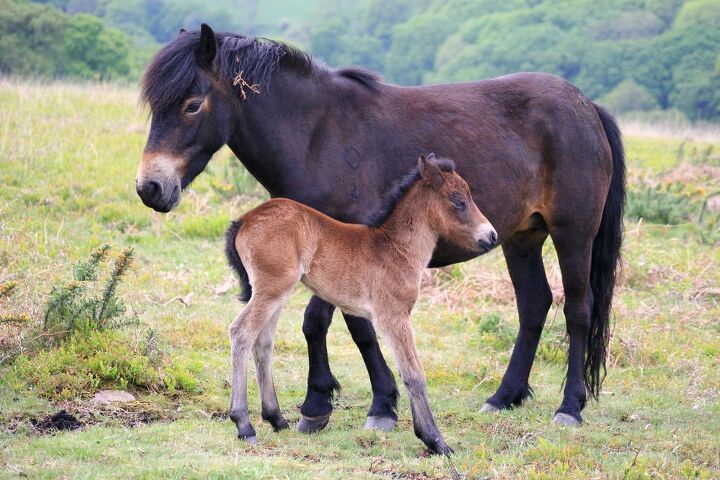
Exmoor ponies are fast learners, and they enjoy working. They are also considered kind, even-tempered, smart, and alert animals that get along well with everyone, including children and adults. In fact, because of their size, they could be a great choice if you are in search of a child’s pony. However, they are strong enough to support the weight of a small adult as well.
Exmoor ponies are kind, even-tempered, and smart.
Overall Description
There are a couple of features that make the Exmoor Pony easier to recognize. First, there is the “toad eye,” which is a heavy upper brow that is able to protect this pony’s eyes from harsh rain and wind. Then, there is the “snow chute” (also known as the “ice tail”). This is the group of coarse, short hairs that are found at the top of the pony’s tail in order to move snow and rain down and away from the animal’s body. Every summer, the snow chute is shed but it grows back every Autumn.
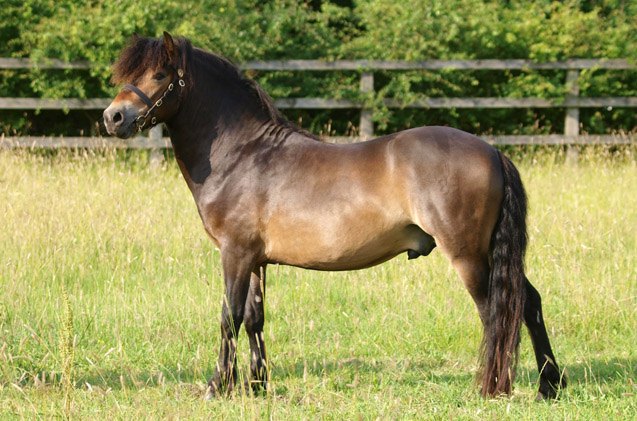
When looking at an Exmoor Pony, you will also notice that the eyes are pronounced and large, the jaw is deep, the forehead is broad, and the ears are small. The ribs are well sprung and the body is deep, while the legs will be clean and short. Also, the hooves will be well shaped, hard, and neat, and the joints will be well developed. The tail and mane are long and thick.
Like other pony breeds that live in cold conditions, the Exmoor Pony features a shiny and sleek coat in the summer, but in the winter, these animals grow a double layer coat in order to enjoy extra waterproofing and insulation in wintry conditions. Their winter coat consists of an underlayer that is woolly and insulating, along with a top layer that features longer hairs that are oily and serve to protect the undercoat by keeping it from getting waterlogged. When it rains, for example, the hairs allow water to move down the sides of the pony, and you’ll notice that the water falls from several drip areas on the body.
The Exmoor Pony features an “ice tail” and “toad eye.”
Colors
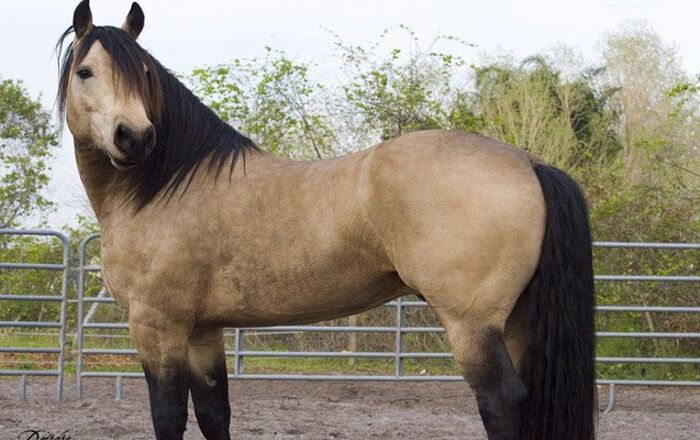
The colors for the Exmoor Pony include variations of dun, brown, or bay with black points. You will also notice mealy markings around the eyes and on the muzzle, as well as on the underbelly and flanks. These ponies will not have any white markings.
Grooming Requirements
Grooming your Exmoor pony should be no different than grooming any other pony or horse. You could start by checking the hooves and cleaning them out with a hoof pick after making sure that they aren’t injured or infected.
Whenever it is necessary because your pony is too dirty, you could bathe him using a gentle equine shampoo. Otherwise, you could use a curry comb to remove any debris, such as mud, that has gotten stuck on the pony’s coat. Use your curry comb in a circular motion but don’t use it on sensitive areas like the head and lower legs. After you’ve removed all of the dirt and debris with your curry comb, you could switch to a dandy brush to remove loose dust from the coat by using swiping and flicking motions. Next, you could use a body brush on the lower legs and the head, as this is a gentler tool that could further polish the coat and remove all of the remaining dust and dirt that you might have missed up to this point. Finally, to clean around your pony’s delicate eyes and ears, you could use a soft, damp cloth. And to keep the mane and the tail looking lustrous and tangle-free, you could simply use a mane comb and tail brush.
Photo credit: eastern light photography/Shutterstock; Marek Velechovsky/Shutterstock; DavidYoung/Shutterstock