Guppy General Description
One of the most commonly available species of freshwater aquarium fish, the guppy is a long favorite amongst aquarium enthusiasts worldwide. Their undemanding and hardy nature makes them perfect for the novice aquarist, and their peaceful temperament make them an excellent addition to most community aquariums.
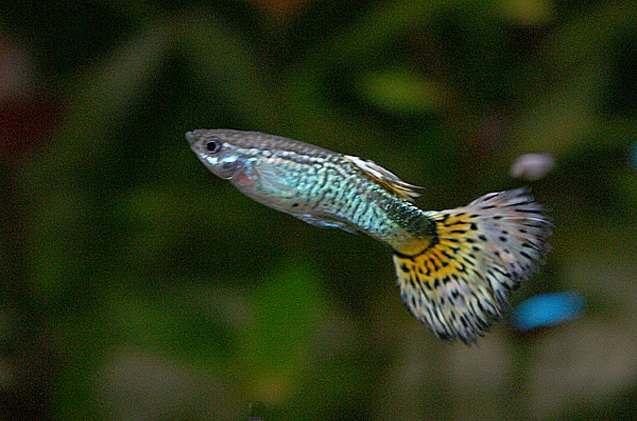
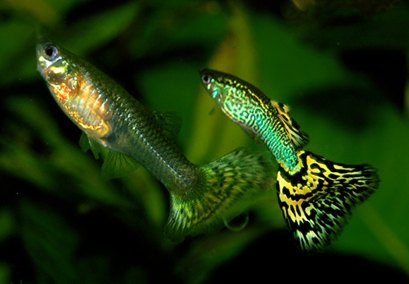
Modern strains of guppy come in a dazzling array of colors, and the males of the species are distinguishable by their brighter colorations and ornate tail fins. The females on the other hand are usually less colorful and have smaller tail fins. Guppy males usually grow up to 1.5 inches in length and the females often grow up to 2.5 inches. Guppies are best kept in groups of 6 or more fish and a group of brightly colored guppies swimming through a well planted aquarium makes for a very aesthetically pleasing sight.
One of the most commonly available species of freshwater aquarium fish, the guppy is a long favorite amongst aquarium enthusiasts worldwide.
Origins
The guppy is native to the North-Eastern regions of South America, but has been introduced to various ecosystems around the world.
Color
Modern strains of fancy guppies come in a virtually infinite number of colors and patterns. Although the females are generally drabber in color than the males, breeders have been able to selectively breed more colorful females of late.
Maintenance and care
Guppies are one of the hardiest species of freshwater aquarium fish and the care that they require is very minimal. Guppies prefer fairly hard, pH neutral water and well planted aquariums with ample swimming space. Guppies thrive in well oxygenated water, but do not like too much turbulence. So it is advisable to use a less intrusive filtration system like a sponge or box filter in the guppy aquarium.
While not a schooling fish, the guppy does well when kept in large groups. They can co-exist peacefully with most other small to medium sized, non-aggressive species of aquarium fish. Care should be taken not to raise guppies in aquariums with larger cichlids or catfish, as the guppies will often be swallowed whole by these larger tank mates.
When given adequate care, a guppy will often live up to 3 years.
Feeding
Guppies are omnivores and will readily accept most flake based aquarium foods. Their diet can also be supplemented with live foods such as mosquito larvae, frozen bloodworms, tubifex worms and vegetable matter such as algae and slices of boiled zucchini.
Guppies are one of the hardiest species of freshwater aquarium fish and the care that they require is very minimal.
Breeding
Guppies are prolific breeders and need no encouragement whatsoever to start breeding in the aquarium. Once they reach maturity the males develop a modified anal fin called a gonopodium which they use to impregnate the females with tiny packets of spermatozoa. Guppies are livebearers and the females give birth to the fry after a gestation period of 28-32 days. Female guppies also have the ability to store sperm from various males for long periods of time, enabling them to give birth multiples times even in the absence of a male. It is important to provide adequate plant cover or hiding places for the fry because guppies will quickly devour their own young when spotted. It is advisable to remove pregnant female from the community tank and into a smaller, heavily planted 5 gallon birthing tank. The fry are free-swimming at birth and can be fed on crushed flakes or baby brine shrimp.
Aquarium varieties
Yellow Lace, Cobra, Snakeskin, Red Lace, Mosaic, American Greens, Full Greens, American Blues, Purple Moscows, Red Albinos, etc.
Photo credit: GFDL/Wikimedia