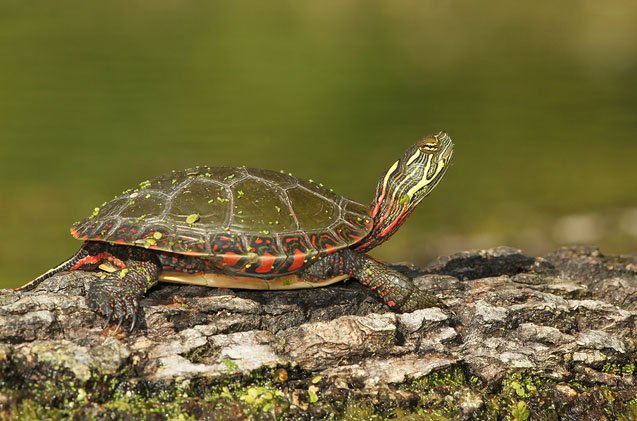
Midland Painted Turtle General Info
There are four subspecies of Painted Turtle, and the Midland Painted Turtle is one of them. The other subspecies are Eastern, Western, and Southern Painted Turtles.
These pets are a good option for beginner turtle keepers, as they are tame, hardy, and enjoyable to watch.
The Midland Painted Turtle is a good option for beginner turtle keepers, as is is tame, hardy, and enjoyable to watch.
Native Habitat
Painted Turtles are found throughout North America, from the southern part of Canada all the way down to northern Mexico.
The Midland Painted Turtle, in particular, is most highly concentrated within the Great Lakes region. You can find this turtle in states like Wisconsin, Indiana, Ohio, Michigan, Illinois, and Iowa.
Overall Description
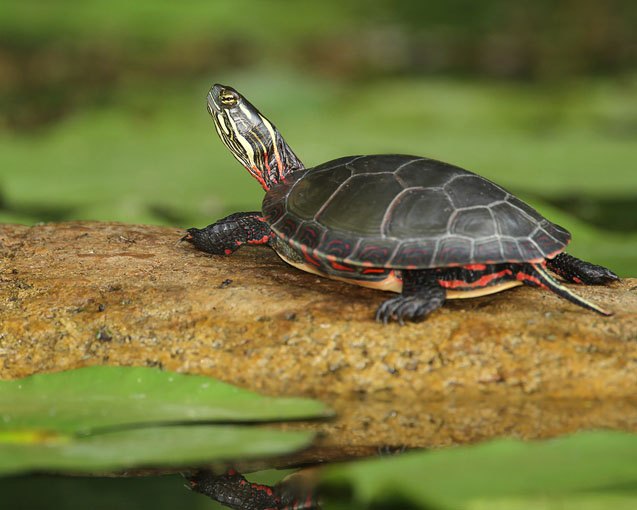
The Midland Painted Turtle features a classic basking style body that is a lot like the body of a Slider Turtle. Its carapace is lightly domed and smooth, the upper jaw features cusps that look like teeth, and the eyes, which are typically yellow, will have a horizontal bar that runs through the pupil.
Males are generally smaller than females, and they are also less domed. They also do not showcase any signs of plastral concavity like other species of turtles. They do have front claws that are elongated, and their tails are a lot longer than the tails of females.
Midland Painted Turtles have shells that can feature a range of colors.
Colors
Midland Painted Turtles have shells that can feature a range of colors, from olive green to black, and there is also a noticeable vestigial vertebral stripe. This turtle’s marginal scutes might feature red stripes, blotches, or bars. The carapace scutes might have light red lines that run along the borders.
In terms of skin color, the Midland Painted Turtle will typically be anywhere from light green to black. You will note broad red lines on the forearms, and the throat and head will feature yellow lines that prominently run across the face from the tip of the turtle’s mouth and nose. These yellow lines will typically transform into a red color towards the turtle’s neck.
Another distinct feature is the yellow blotch or line that is often seen directly behind the Midland Painted Turtle’s eye.
Environment
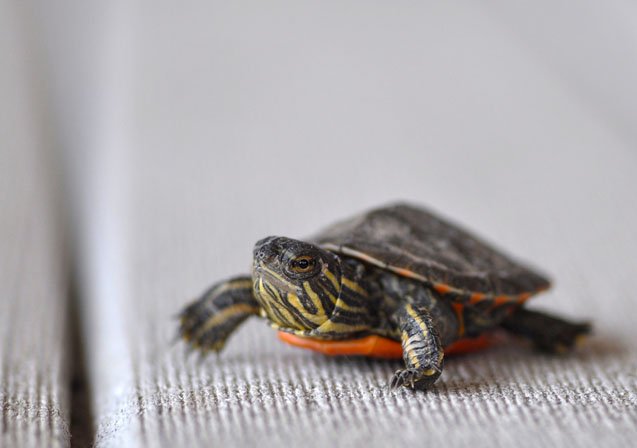
A single adult male Midland Painted Turtle will be comfortable in a 55-gallon aquarium as a minimum, but a single adult female will need more room, so a minimum of 125 gallons would be a good place to start. If you add more Midland Painted Turtles to your enclosure, you will have to increase the size of the aquarium tank by half. So, for example, two males would need a 75-90 gallon tank.
Because these turtles enjoy basking, you will need to provide your pet with a UVB light and a heat lamp. Set up a large enough basking area that is made of flat rocks, smooth rocks, gravel, sand, dirt, driftwood, or any other platform that will be non-abrasive and support the weight of your pet. Then keep the temperature there anywhere from 85-90°F.
Maintain the air temperature in your Midland Painted Turtle’s enclosure anywhere from the low to mid 80s Fahrenheit. The turtle’s water temperature should be kept in the low to mid 70s, so you should use a safe and high quality water heater.
Midland Painted Turtles also enjoy swimming, so the depth of the water in an enclosure should be deep enough that they can completely submerge and swim around. Hatchlings will do well in shallower water of about 4-6 inches, but the water should be much deeper for juveniles and adults. Make sure that the water is always clean and filtered, and provide spots underwater where the turtle can stop and rest.
In terms of aquatic substrate, it is optional. You can keep the bottom of the turtle’s enclosure bare, or you can add sand, fine-to-medium sized gravel, or river rock.
Midland Painted Turtles are a good option for pet owners who are new to keeping turtles in their homes.
Care Requirements
This is an omnivorous turtle species, so a well-rounded diet is key. You can provide your pet with a commercial turtle diet, along with feeder fish, shrimp, and non-toxic aquatic plants like water hyacinth, water lilies, water lettuce, duckweed, pondweed, hornwort, frogbit, water milfoil, water starwort, and water fern.
These turtles will also enjoy eating vegetables, such as squash, beet leaves, collard greens, zucchini, romaine, endive, kale, mustard greens, dandelions, escarole, and red leaf lettuce.
You can even provide your pet with some fruit, and Midland Painted Turtles will like feasting on bloodworms, mealworms, and crickets too.
Behavior
Midland Painted Turtles are a good option for pet owners who are new to keeping turtles in their homes. These animals are hardy, and they are also tame when they are around people, so they will not always be hiding or running away when you come near their enclosure like so many other turtles do.
If you want to house more than one turtle together, Midland Painted Turtles do well in communities with other Painted Turtle species, as well as other turtles from the same region that they are from. They should all be of comparable size, and each turtle should have plenty of space. However, you must keep an eye out for aggressive behavior, even in spacious enclosures.
Photo credit: Brian Lasenby/Bigstock; Iowa-X2/Bigstock