Paradise Fish General description
Looking for some colorful fish to spice up your tank? Look no further than Paradise fish, a species that has been tickling the eyes of fish owners for well over a century. Paradise fish are a remarkably colorful species of freshwater fish belonging to the gourami family. They were actually the first species of tropical fish to be imported to Europe nearly 150 years ago, giving them a rather rich history as pets that is uncommon within this species. They have remained popular after all of these years for a reason: these fish really pop in a tank and it is practically impossible to tear your eyes away from them.
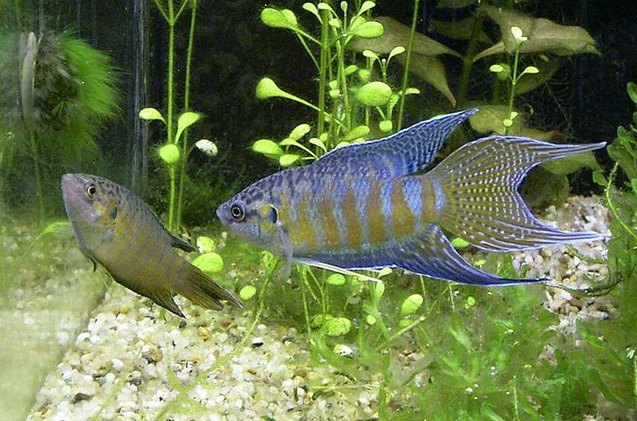
So what do these glorious creatures look like? Paradise fish have thin, rectangular bodies and are characterized by their long flowing fins. Like gouramis, they also have two thread-like pelvic fins and adult paradise fish tend to grow to around 4 inches in length. Their beauty and extremely hardy nature have made them a popular choice among aquarists for decades. It’s practically impossible to find a home aquarium without at least one of these glorious fish inside. But are they the right fish to bring home to your tank? You’ve come to the right place to find out. Keep your eyes glued to this page and scroll away. We are about to reveal everything worth knowing about Paradise fish. All you need to read the info and make your decision.
Paradise fish are a highly colorful species of freshwater fish belonging to the gourami family.
Origins
Paradise fish originate from the paddy fields and ditches of East Asia. The fish currently exist all over the world as pets. But East Asia is their initial origin.
Color
Wild paradise fish usually have both red and blue markings. In modern times, solid red and solid blue paradise fish have been produced by breeders.
Maintenance and care
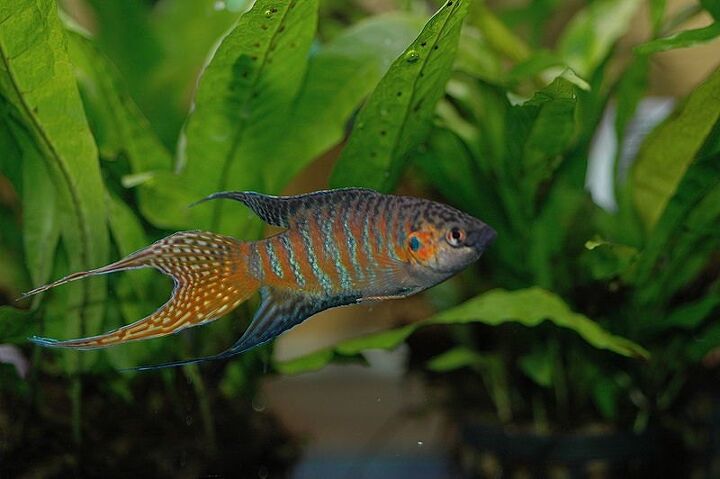
Paradise fish are extremely hardy and can survive in a range of water and tank conditions. This versatility and relative ease of care is a huge reason why they have remained so popular for so long. However, to keep them at their healthiest, a heavily planted aquarium with moderately soft water is preferred. They can adapt to other scenarios, but that’s the best environment to create for them. In its natural habitat, the paradise fish lives in stagnant pools of water, thus the paradise fish aquarium should have little or no surface water movement for the sake of the fish’s serenity as well as far more important matters. Like gouramis and bettas, paradise fish are also a species of labyrinth fish and can breathe surface air. Thus it is important to ensure that the paradise fish’s aquarium has sufficient surface area for it to breathe. So, maintaining that calm surface should be a top priority of any Paradise fish owner.
Paradise fish are highly territorial towards each other. For this reason, it is advisable to keep only one male with a group of females in the aquarium. If multiple males are introduced to the same aquarium, they will fight each other aggressively (typical). Unless you are planning on running an illegal, cruel, and impractical fish fighting league, it’s best to limit your tank to one male Paradise fish.
Slow moving fish with long fins like goldfish or angel fish also make bad tank mates for the paradise fish because it will start nipping and harassing them. Paradise fish can also start competing for dominance with other aggressive tank mates of similar size. For this reason, it is best to house them with larger non aggressive species of cichlids and gouramis. Paradise fish might be pretty, but they can also be rather dangerous without the right aquarium partners. So be careful with how you populate your tank if you plan to include any Paradise fish.
Like killifish, Paradise fishes too are avid jumpers and care should be taken to adequately cover the top of the paradise fish aquarium. You don’t want any escape artists acting up and causing trouble. So use an adequate cover to ensure that there aren’t any issues in this regard.
Feeding
Paradise fish are omnivores and will readily accept most flake and pellet based foods. However, it is important to supplement their diet with live foods such as mosquito larvae, bloodworms and daphnia. A healthy balance between these to elements of your Paradise fish’s diet will lead to a happy and healthy life for your colorful new gilled friend.
Paradise fishes are extremely hardy and can survive in a range of water and tank conditions.
Breeding
Male paradise fishes are often much more brightly colored than females. They also develop much longer finnage when they reach sexual maturity. Like gouramis and bettas, paradise fish are bubble nest builders. To breed them, the male and female fish should first be conditioned separately on a protein rich diet of live or frozen foods. Once the female starts to ripen with eggs, the pair should be introduced in a heavily planted breeding tank. The male will promptly start harassing the female while simultaneously building a bubble nest. Once the nest is complete, the male will entice the female underneath the nest where they will spawn in an “embrace” characteristic of fish in the gourami family. The male will wrap his body around the female and fertilize the eggs as she releases them. This embrace will occur a few times until the female has released all her eggs. Once spawning is complete the male will turn extremely aggressive towards the female. These fish aren’t known for having particularly healthy romantic or parental relationships. So at this point, the female should be removed from the breeding tank and the male left to take care of the eggs and fry. The fry, once hatched, can be fed on a diet of infusoria, baby brine shrimp and micro worms.
Aquarium varieties
Red Paradise, Blue Paradise, Albino Paradise are all good options that will suit this particular breed of fish rather well.
Photo credit: Daniella Vereeken/Flickr