Pixie Bob Breed History
Washington state cat breeder Carol Ann Brewer claims the Pixie Bob is the result of the naturally occurring breeding of a domestic cat with a bobcat, however DNA testing has failed to detect any gene markers in the Pixie Bob’s DNA to establish a relationship to the Bobcat. Brewer bought a polydactyl cat in Mount Baker, Washington in 1985. The male cat had a short bobbed tail. In 1986, Brewer rescued another feral tom that was larger, and also had a bobbed tail. Even in an emaciated condition, the stray weighed 17 pounds and was as tall as Brewer’s knee. The male mated with a brown spotted female that lived next door to Brewer. One of the kittens, Pixie, became the foundation for the breed that was developed over the next couple of years. Brewer used 23 cats from the area around the Cascade Mountains, all of whom were said to be bobcat hybrids. The cats she produced were registered and were accepted in the TICA “Exhibition” Category in 1993, winning “New Breed and Color” status in 1996, and Championship status in 1998. It is classified as a “Newer Natural/Regional Breed.”
The Pixie Bob is an active, social cat with a bold and playful spirit.
Breed Traits
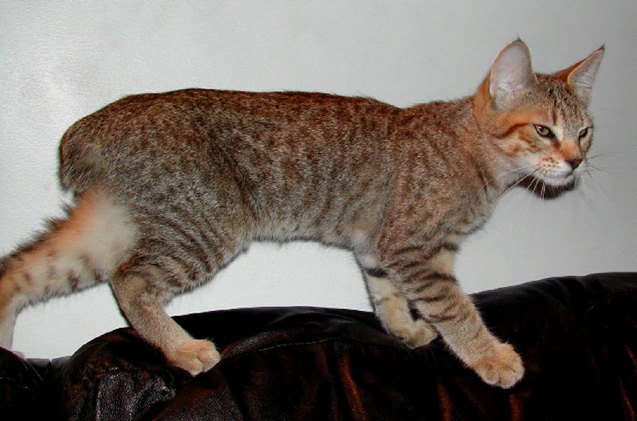
The Pixie Bob is an active, social cat with a bold and playful spirit. They like to be in multi-animal households, and express themselves with a range of vocalizations from chirps and chatters to make-believe growls. They rarely, if ever, meow. Pixie Bobs will follow their owners around and are known for head butting to get attention. They like games of fetch, and many are quite agreeable about walking on a leash. They have a reputation for easily amassing a large vocabulary and are very responsive to verbal commands including reasonably complex phrases.
Overall Description
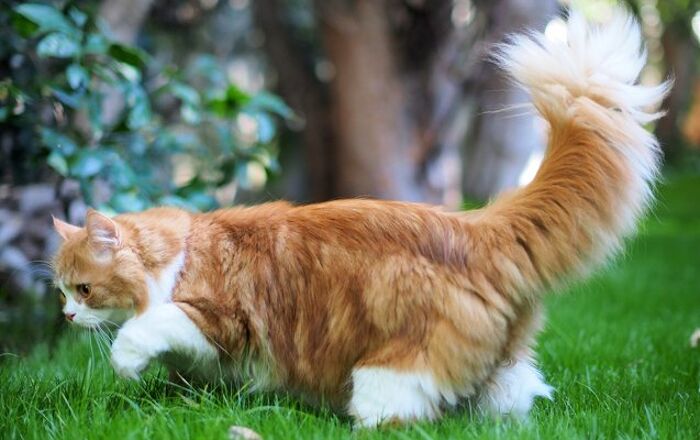
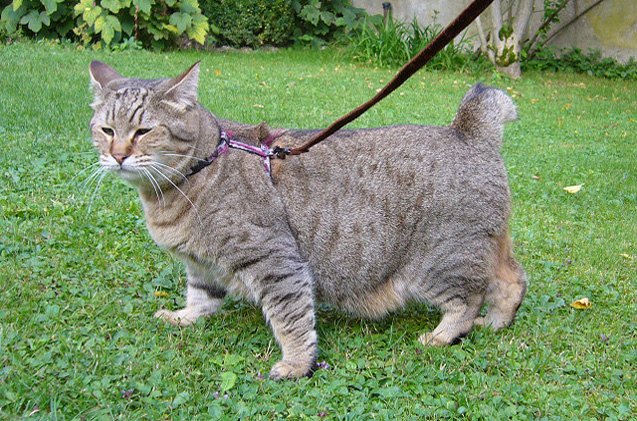
Pixie Bobs are domesticated cats that resemble the North American Bobcat. To be considered a Pixie Bob, a specimen must be able to claim lineage back to StoneIsland Pixie. Individuals can be large in size, but the average weight for a Pixie Bob is 11 pounds. They have black fur on the bottoms of their feet, black pads, and their ears are tufted and tipped. They have black lip and eye skin, but white fur rings the eyes, and is present on the chin. Often their whiskers are both black and white. The pattern on their fur is much like that of a Bobcat with additional reddish tones. Most are short haired, but some Pixie Bobs are best described as “shaggy.” Their eyes are triangular shaped under a heavy, prominent brow. Their tails range from a non-existent “rumpy” to 2-4 inches in length. (Some have long tails.) Overall the head, which is one of the most important characteristics of the breed, is shaped like a pear. Many are polydactyl, having as many as seven toes on one foot.
Colors
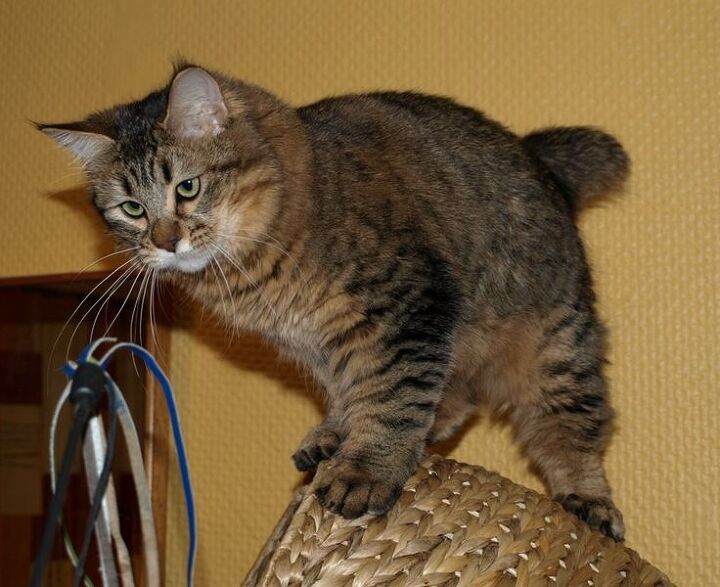
These cats have colorations described as warm and cool tones. The warm tones allows for shades of brown, gold, russet and tan, while cool tones include grays and blacks. Their patterning includes both spots and stripes and they may or may not have rosettes. There is always some degree of ticking.
Grooming Requirements
Pixie Bobs have a double coat varying in length from short to shaggy. It can be mildly coarse, or soft to the touch. The general recommendation is for brushing or combing twice a week to keep dead hair out of the coat. With their dense fur, Pixie Bobs can be subject to matting.
Photo credit: Donna Cox/ Wikimedia Commons; Nathalie Bent/Wikimedia Commons