Puginese Basics
Also referred to as the Peke-A-Pug, Pekeapug, Pug-A-Peke, and Pugapeke, the Puginese is a great family pet and companion that doesn’t require a lot of physical activity and will be more than willing to show you how much he loves you every day.
To learn more about this designer dog breed and to figure out whether or not it is the right choice for you, keep reading for a bit of helpful information.
The Puginese is a cross between a purebred Pekingese and Pug.
Origin
The Puginese is a designer dog breed that can trace its original ancestry to China.
Pedigree

The Puginese is a cross between a purebred Pekingese and Pug.
Food / Diet
To keep your Puginese happy and healthy, choose a food that’s designed to meet your pet’s nutritional needs with the help of natural, whole food ingredients. It’s best to avoid low quality brands that use poor ingredients along with allergenic or artificial ingredients.
You can feed your pet around ¾ cup of a high quality dry food every day, but split this amount up into multiple servings. Keep in mind, too, that your dog may require more or less food, depending upon his age, size, activity level, and needs. And if you are also going to be giving your Puginese some high quality canned food for dogs, simply reduce the amount of dry food accordingly so your pooch won’t overeat and gain too much weight.
If you have any questions regarding how much you should be feeding your Puginese to maintain his health and ideal weight, talk to your vet.
The Puginese is often described as cheerful and playful, as well as social and affectionate.
Training
When it comes to training, the Puginese is considered moderately easy to work with. You should expect that results will occur gradually, so remain patient, gentle, calm, and consistent in your approach. Don’t be harsh with your dog, but establish yourself as the pack leader. Use positive techniques that include rewards, praise, and treats to encourage and reinforce good behaviors.
With the right obedience training, you can control the sometimes stubborn behavior that is exhibited by the Puginese, and you can also keep barking under control. As with other breeds, the sooner you start to train your dog, the better.
Weight
A toy to small-sized breed, the Puginese weighs between 7 and 18 pounds.
Temperament / Behavior

The Puginese is often described as cheerful and playful, as well as social and affectionate. These sweet pooches will bring a smile to your face with their loyalty and love. They also make good watchdogs because they will bark to alert you if someone looks suspicious.
Known for being good-natured, the Puginese makes a great family pet. These canines are willing to please, enjoy spending time with their humans, and get along well with children. With proper socialization, your Puginese will also get along with other pets, including other dogs.
Common Health Problems
Because the Puginese is a hybrid canine breed, it could be prone to the health ailments that most commonly affect its parent breeds. That’s why it’s a good idea to purchase your dog from a reputable breeder who can prove the health of the animal’s parents.
It is important to note that hybrid canines can be surprisingly hardy and healthy. Plus, there is no way to predict an individual dog’s long-term health, and there is no guarantee that your pet will inherit any health problems from his parents.
Some of the health problems that affect the Pekingese and the Pug include respiratory issues, skin ailments, heart issues, epilepsy, eye problems, back problems, cryptorchidism, allergies, hydrocephalus, cleft palate, patellar luxation, intervertebral disk disease, fold dermatitis, vaccine sensitivity, Legg-Calvé-Perthes disease, nerve degeneration, and hip dysplasia.
Life Expectancy
The Puginese has an average lifespan of 12 to 14 years.
Exercise Requirements
You can expect a Puginese to be fairly active, so you should be able to provide your pet with an opportunity to get physically active and exercise every day.
These playful dogs will thoroughly enjoy running around off-leash in an enclosed, safe backyard or at the dog park. They will also have fun while on daily walks or jogs with you.
Other ways to keep your pet active include playtime with toys inside the house, and interactive games, such as fetch, in the great outdoors.
Known for being good-natured, the Puginese makes a great family pet.
Recognized Clubs
The Puginese is not recognized by the American Kennel Club, as it is considered to be a hybrid breed. However, this breed is recognized by the American Canine Hybrid Club (ACHC), the Designer Breed Registry (DBR), the Designer Dogs Kennel Club (DDKC), the Dog Registry of America, Inc. (DRA), and the International Designer Canine Registry (IDCR).
Coat
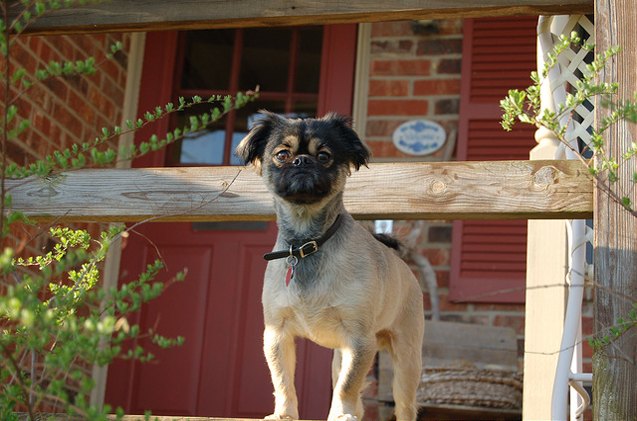
A Puginese can have a smooth, medium length coat that requires a moderate amount of grooming, or the coat could be shorter like the Pug’s or longer like the Pekingese’s.
Generally, these dogs should be brushed a few times a week to keep the fur clean, smooth, and healthy, and you can bathe your pet whenever he gets too dirty.
Puppies
Because the Puginese is a small dog when fully grown, puppies will be tiny and delicate. Ensure your pup has a safe environment in which to learn and grow. Also, supervise his interactions with small children and other pets to ensure he doesn’t accidentally get hurt.
Early socialization and training will help this breed learn the rules of the house more easily. Make sure your puppy is exposed to a variety of people and other animals so that he will grow up to be confident in various situations.
Photo credit: Pekingese/Flickr; Leta Hix; adogslifephoto/Depositphotos.com