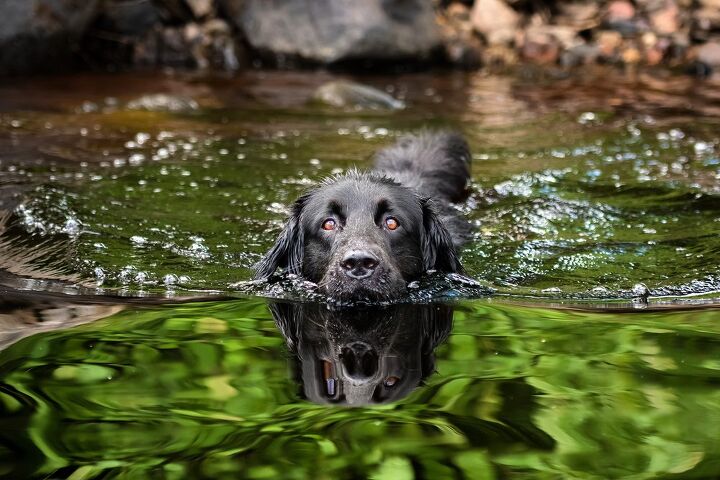
Does your doggy like to paddle in the water? Don’t jump into the deep end until you read up on these important swim safety tips for dogs.
As the mercury begins to climb and we enter the dog days of summer, many of us escape the heat in our local swim spot. Dogs seek this relief as well. Here’s are a few things to consider before your dog dives into the water.
I have been coast to coast to coast with my pack of dogs. We have enjoyed sandy beaches, meandering rivers, rocky shores, blue lakes, oceans and concrete pools. Sometimes finding a good swimming spot can require a little bit of detective work. Ask in campground offices, pet stores and on social media where good spots for a quick dip are. Some areas have designated dog beaches and swimming holes, while others take a more casual approach.
Obey all posted signs. If a sign says “No dogs”, it means no dogs. You don’t want to swim on their no-dog beach anyways!
Related:10 Dog Breeds That Can’t Swim
Some dogs are waders, some are jumpers, some are toe tippers. There’s room for all types. Just be sure to not force your dog to do something he isn’t comfortable doing. Lots of praise and encouragement can turn a toe dipper into a wader. But if your dog isn’t comfortable taking their feet off the solid ground, that’s okay too!
While breed type can be a huge factor in determining if your dog will take to the water like a duck, or sink like a rock, there are exceptions to every rule. No one knows your dog better than you.
Don’t throw the dog. Seems a little surprising to have to say this, but seriously, don’t throw the dog. No matter how well your dog swims, don’t toss him in. Besides the potential injury and the whole drowning thing, it’s just not cool. It’s cool if your dog wants to jump in, slide in, wade in, run in, in safe conditions, it’s all fair game as long as it’s the dog’s choice.
I tend to avoid peak times; less people means less drama. Plus, if my dogs are skinny dipping, I want them to have some privacy! Peak times tend to be the hottest part of the day, which I know makes sense as to cool my dogs off, but dogs tend to drink more when it’s hot out, and I don’t want them to drink from our swimming spots. So I tend to take them earlier in the morning, which gives them a nice cool swim and plenty of time to dry off.
Related:Top 10 Swim Gear For Your Dog
Avoiding people is one thing, but avoiding wildlife is also high on my list. Many wild animals are most active at dawn and dusk. These include predators and prey. Either way, skipping out on the dawn and dusk swims means we have less chance of encountering wildlife. Many of which are drawn to water sources during these times.
Before we go for a swim, I ensure my dogs have plenty to drink. I even bring along some baited water to encourage them to drink from a known water source, opposed to where we are swimming. This has allowed to avoid mishaps with giardia or other water borne pathogens.
By encouraging the dogs to drink from water I bring along, it also helps me monitor how much they are drinking.
Hyponatremia (excessively low sodium levels) is a very rare, but fatal condition found in dogs who love the water. Swimming, playing fetch, chasing waves can result in a dog ingesting too much water. Any size dog, who enjoys the water just a little too much can be at risk. Early symptoms include a loss of coordination, lethargy, vomiting, bloating and glazed eyes. Water intoxication is life threatening and veterinary assistance must be accessed immediately.
A dog suffering from this condition may appear to have a broken tail. The tail will either stick out a few inches then drop down, or hang limply. It’s not actually that the bones are broken, but that the muscles around the tail are affected. Veterinarians believe it is linked to over-exertion, but limber tail is definitely made worse by repeated plunges into water that is considerably colder than the air temperature.
Swimming is hard work! Sometimes dogs get a little too excited chasing a ball, or playing in the water that they forget just how hard they are working. It’s our job to ensure that they limit their swim sessions to an appropriate length of time.
A properly fitting PFD, in this case a Pup Flotation Device, is a great idea. Even the best of swimmers can benefit from the added flotation boost. Look for bright colors to aid in visibility as well.