Kathiawari Horse Breed History
Also known as the Kathi, Cutchi, and Kutchi, the Kathiawari Horse is an equine breed from India that comes from the Kathiawar peninsula.
Originally, these horses were bred to be used as warhorses and cavalry mounts that would be able to travel over long distances even when there were small rations to go around.
Kathiawari horses defended their masters in battle even when wounded.
Experts believe that there were horses living along the west coast of India for a long time before the establishment of the Mughal Empire. However, it was not until the Mughal Empire that Arabian horses were taken to the Indian subcontinent. Those horses were bred with the local desert horses, creating the ancestors of the Kathiawari Horse today. Mongolian Horse blood was later added to the breed in order to improve it, and this practice continued even throughout the British Rule of India.
Aside from the Kathiawar peninsula, the Kathiawari Horse can now be found in other Indian states, such as Maharashtra and Rajasthan. The government of Gujarat is in charge of maintaining studs within a few districts that include Rajkot, Surendranagar, Porbandar, Amreli, and Junagadh. Some of these are aimed at preserving the Kathiawari Horse breed, while others seek to improve only the local stock.
The Kathiawari Horse Breeders’ Association maintains a breed registry for the Kathiawari today.
Breed Traits
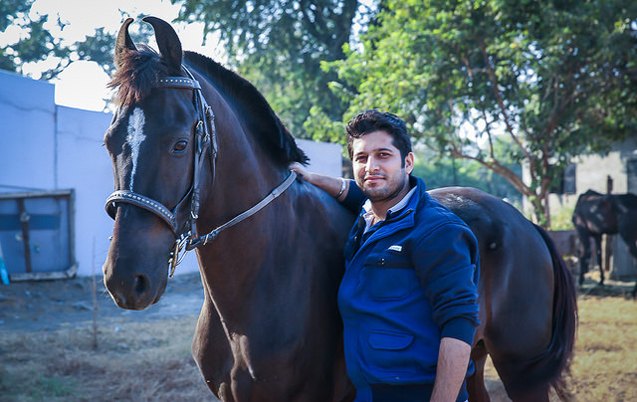
The Kathiawari Horse is known for having an affectionate and faithful personality. These loyal horses are also extremely brave. In the past, they were renowned for their loyalty and their courage, particularly in battle, when they would defend their masters even if they were wounded.
In addition to their bravery and loyalty, these horses are also highly active and intelligent, so they do well with all levels of riders, and they can perform well in a variety of disciplines. They make wonderful riding horses, thanks to their stamina, strength, and temperament.
The Kathiawari Horse is an equine breed from India.
Overall Description
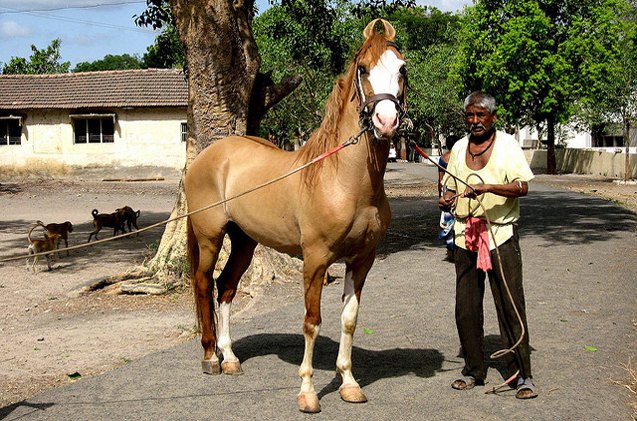
The sturdy Kathiawari Horse resembles Arabians and Marwari horses closely. In fact, the Kathiawari and Marwari horse breeds are often thought to be the same breed even though they are distinct from one another. When you look more closely, you will notice that the Kathiawari Horse is a bit stockier than the Marwari, which has fine features. And Kathiawari horses usually do not stand any taller than 14.2 hands, or 56.8”. Like the Marwari, the Kathiawari also features curved ears, but its ears will be curved in a bit more tightly, and they will also be shorter. Also, when compared to the Marwari, this breed will not have the same Roman nose.
You will also note that this breed features a concave facial profile, as well as a short muzzle and a broad forehead. The eyes are large, and the nostrils are rounded and large too. However, this breed’s most distinguishing feature is its ears, which curve inward and touch each other or might even overlap one another at the tips.
The neck of this equine breed should be crested, and the horse should have well sloping shoulders and prominent withers. The body of the Kathiawari is relatively short, but these horses do have well-proportioned legs and well-developed quarter, and their tail and head are both set high.
Kathiawari horses are physically sound, and they are resistant even to severe weather conditions. Their coat is refined and shiny, the hair is fine, and the mane and the tail are bushy and long.
The Kathiawari is known for being affectionate and faithful.
Colors
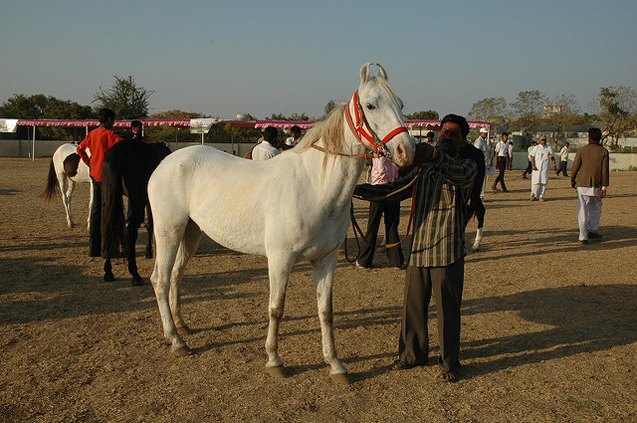
The Kathiawari equine breed can feature an array of colors that include bay, gray, chestnut, white, buckskin, dun, champagne, grullo, brown, roan, cremello, perlino, and palomino. However, dun, bay, gray, and chestnut are the most common colors seen amongst these horses.
These horses can also feature all of the gray color variations, including dappled gray, flea bitten gray, and iron gray. They can even be blue dun or yellow dun.
However, you will not find any black Kathiawari horses, and pinto patterns are also rare.
Grooming Requirements
Grooming your Kathiawari Horse regularly will ensure that his skin and coat remain smooth, shiny, attractive, and healthy. These loyal and affectionate horses will also thoroughly enjoy the attention that you can give them during every grooming session.
Using a curry comb, dandy brush, and shedding blade, you can easily and effectively remove all of the dirt, debris, and excess hair that has accumulated throughout your Kathiawari’s coat while spending time exploring the great outdoors. For sensitive areas, such as the face and legs, you can use a body finishing brush, as well as a dampened cloth.
Focus on keeping the long and bushy mane and tail of the Kathiawari Horse tangle-free and smooth by using a mane comb and a tail brush. And make sure each grooming session also includes the use of a hoof pick, which will allow you to thoroughly clean out debris from your horse’s hooves and examine them for injuries or infections.
Photo credit: Jessica Ryann/Flickr; horsewishperer/Flickr; Saif Patel/Flickr