On-Leash Dog Greetings: Yea or Nay?

Published A Few Days Ago
ADVERTISEMENT

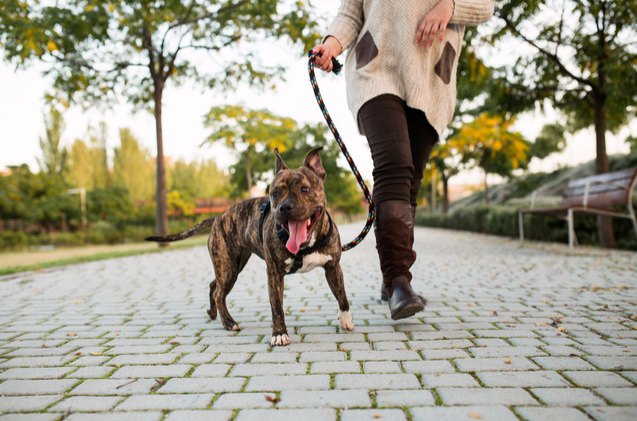
Letting your pup greet other dogs while on leash isn’t always fun and games. Keep these tips in mind the next time you’re on a walk.

If you’re a dog owner, you’ve probably been there countless times. You’re taking Sadie for a walk down the sidewalk and an oncoming dog, also on leash, is approaching you. What should you do? Should you let Sadie greet the other dog when it reaches you, or is it better to just keep walking?

I recommend you avoid greeting the other dog if:

    Yes, that’s a lot of ifs. And I’d bet most of us can check off at least one of those boxes.

    Related:How Dog-Loving Strangers Ruin Well-Trained Dogs

    Have a Sidewalk Strategy

    Now I am all for dogs interacting and playing, but the sidewalk just isn’t the place. First of all, the impolite (by doggie standards) face-to-face direct approach of an oncoming dog can cause your pup a great deal of stress as it creeps closer and closer. By the time that unfamiliar dog reaches you, your dog’s anxiety has been building for half a block, so the likelihood of an on-leash confrontation is much higher than if the same two dogs met naturally in an off-leash park, where they could approach more politely from a curved angle without being forced to make direct eye contact.

    Additionally, the leashes inhibit both dogs’ greeting body language, making the greeting awkward at best, and at worst, threatening to one or both dogs. If your leashes get tangled or you start to pull your dog back, it only exacerbates this botched greeting and increases the risk.

    Related:Should You Bring Your Nervous or Reactive Dog to the Dog Park?

    Many owners think that on-leash scuffles start without warning. I’m sure there is a warning, but unless you’re a dog, you’re unlikely to notice it in time to intervene. So if you can’t predict a confrontation, all you can do is avoid putting your dog in that situation.

    Leashed walks are a time for your dog to spend with you, not a time for him to be dragging you down the street in search of his next playmate. It’s not fair to expect him to walk politely with you on a loose leash if he is also allowed to drag you towards a dog that is approaching on the sidewalk. If your dog is the playful type, find places that allow him to romp freely: dog parks, doggie daycare facilities, playdates with a friend or neighbor, or supervised play groups at a training or boarding facility.

    Pick up the Pace

    Once you’ve resolved to put your dog’s safety first and avoid on-leash greetings, how can you avoid other dogs walking down the street? Practice a technique I call “the New Yorker walk.” It has four components:

      By channeling your inner New Yorker and making your dog’s safety a priority, you’re ensuring that your dog won’t have negative on-leash experiences that could have a long-term impact.
      ADVERTISEMENT

      ADVERTISEMENT

      You May Like

      How To Choose A Winter Coat For Your Dog Like A Canadian Skijorer

      Kevin Roberts lives in Winnipeg, Manitoba, Canada. To say it gets cold there in the winter is an understatement. It’s called “Winterpeg” fo…

      Yellow-Footed Tortoise

      The Yellow-Footed Tortoise is one of the most popular and beloved tortoise breeds in the pet trade. It is shy, so these animals will not like being handled.

      Swedish Vallhund

      The Swedish Vallhund is energetic and eager to make friends. This breed comes with 3 different types of tail: bobtail, a stub tail or a full curl tail.

      Lab Pei

      The Lab Pei is a mix of Labrador Retriever and Chinese Shar-Pei. He makes a wonderful addition to any family, getting along well with children and pets.

      Best Dog Training Books

      Dog training books can offer invaluable insight into the expertise and experience of various professional trainers and dog behaviorist experts.

      How to Help a Semi-Feral Cat Get Used to Life Indoors

      Stray cats aren''t an uncommon sight. If you''re thinking about asking one to move in, here are some tips on how to help make the transition easier.

      Highlander

      The Highlander resembles a wildcat, making it a truly unique looking breed. Even though they may look wild, they are actually wonderful, gentle pets.

      Global Pet Expo: A Royal Bed Designed Especially for Your Furry Duches

      Trying to see everything at the Global Pet Expo 2018 is ruff. And we''ve found the softest ever dog beds... don''t mind us while we catch a little nap!

      Standard Chinchilla Rabbit

      The Standard Chinchilla Rabbit is known to be sweet, docile creature who have no problem being picked up by their owners or strangers.

      Tame Your Cat’s Hairballs With Wellness Natural Hairball Control For

      Hairballs aren''t welcome in any home - or in your cat''s stomach. Keep them under control with Wellness'' new Natural Hairball Control dry cat recipe.

      The Basics About Dog Body Language

      Your pooch doesn''t need to say a word for you to understand what he''s feeling. Understanding dog body language tells you everything you need to know.

      Product Review: Tall Tails Cape Pocket Towel

      Splish, splash! Oscar takes a bath and dries off with the Tall Tails Cape Pocket Towel It’s a bird! It’s a plane! No, it’s just Oscar after…

      American Sable Rabbit

      The American Sable rabbit has soft, fine, dense coat that requires more grooming that the average short-haired rabbit. An active and friendly rabbit.

      New Zealand Rabbit

      The New Zealand Rabbit is large, muscular animals that has a beautiful coat. They are calm, and generally good with children and other pets.

      What Is Megaesophagus in Cats?

      A big word and a big problem. What is megaesophagus in cats, what are this disorder''s causes and how do you treat it? Read on to find out.