
Maltese Basics
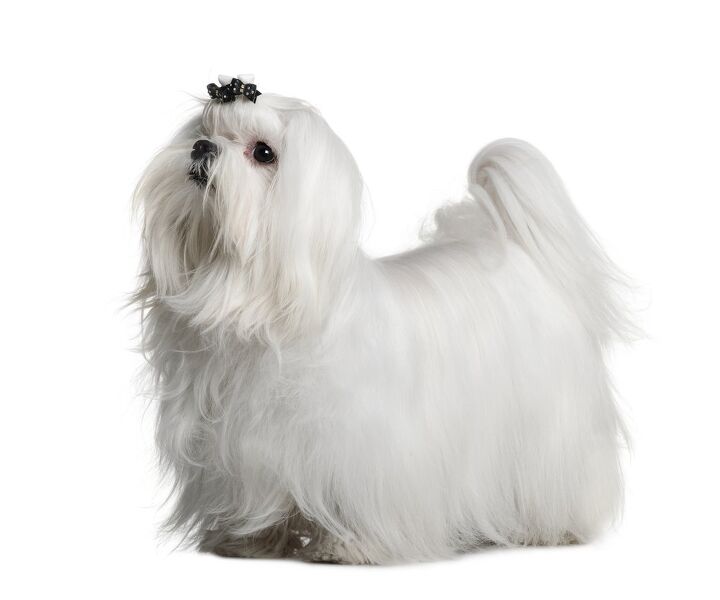
Wrapped up in mounds of fur and often finished with a bow on top, the Maltese is a bundle of joy presented in an adorable package. It’s not hard to see why this breed was once used as a royal lapdog and companion. Admirable, gentle, playful, energetic, bold, and feisty, the breed loves to run, play and even stand up to bigger dogs.
You may find that your Maltese can be a bit reserved with strangers and likes to bark, but on the whole, this breed makes excellent companions. Read on to learn more about this wonderful breed.
Admirable, gentle, playful, energetic, bold, and feisty, the Maltese loves to run, play and even stand up to bigger dogs.
Origin
The Maltese is known as the oldest of all dog breeds and the oldest of European toy breeds. In fact, Charles Darwin placed this breed as far back as 6000 B.C. Although no one can be 100 percent sure where it came from originally, most believe the Maltese come from the island of Malta in the Mediterranean Sea, hence its name.
When the Crusaders and nomadic tribes brought them to England, women liked to carry them in their sleeves. Royalty took a shine to the Maltese – Mary Queen of Scots, Queen Elizabeth I, Queen Victoria, Josephine Bonaparte and Marie Antoinette all owned a Maltese. It was shown in American in 1877 as Lion Dogs.
Pedigree
Since it is known as the oldest dog breed, it’s impossible to trace what dog the Maltese was bred from. Some think this breed originated from Asia and may have helped to breed the Lhasa Apso, Tibetan Terrier, Tibetan Spaniel and the Pekingese. The breed also played into ancient Egyptian culture around the times of 300 to 600 B.C., and was featured on Greek vases around 500 B.C.
It is also said that this breed could be a descendant of a Spitz-like dog that is used to hunt in marshes and wooded areas in Southern Europe (Maltese have been used for controlling rodents). Since it had been kept on the island of Malta, the Maltese had have been bred true for centuries.
The AKC recognized the Maltese in 1877.
Food / Diet
Maltese dogs have a history of digestive issues, so it’s important to know what you are feeding it. Make sure your dog food has no fillers, such as corn, gluten or by-products. It is safe to feed them human grade food (Note: This does not mean table scraps). This dog does well with fruits, vegetables and quality proteins.
Wrapped up in mounds of fur and often finished with a bow on top, the Maltese is a bundle of joy presented in an adorable package.
Training
Known to be an intelligent breed, the Maltese is easy to train but hard to housebreak. The best way to housetrain is to use a crate or keep your dog under vigilant supervision. Keep them with you in the house on a leash, and if you can’t watch them, your dog should be in its crate at these times. It will also help if you take them outside to do its business before and after playing and eating, when they wake in the morning, and before they go to sleep for the night. Be sure to use treats and lots of praise when your Maltese goes outside.
The Maltese needs plenty of socialization and exposure to different people, places and animals starting from a young age. The breed is naturally inquisitive, but if not socialized properly, this dog may become shy and fear aggressive. Socialization should always be is fun, and feel free to use treats and other rewards when your dog reacts positively toward strangers. You’ll have to keep an eye (or an ear) out for barking issues – this breed can get in the habit of barking excessively, and it’s a hard habit to break.
Before settling on a Maltese, be sure that you have the time to devote to training your dog. This breed requires time and lots of love – but in our opinion, it will be well worth it.
Weight
Both male and female Maltese dogs fall in the four to seven pound range.
Temperament / Behavior

Gentle, loving, and cheerful, the Maltese loves to play and have fun. You’ll soon find it hard to keep up your pooch, as it is full of energy and enthusiastic about everything. You may notice that your dog will run in circles or at a high speed in different directions – don’t worry, it’s normal.
The perfect pet for the first time dog owner, the Maltese is eager to please and protective its owner. This being said, you’ll have to watch out when other people come around, as your dog may see these people as a threat.
It’s also important to remember that this breed is not afraid of anything. As well, it may not like or be interested in objects or animals that are larger than it is. Since it is quite bold, your Maltese will be quick to alert you if it hears any suspicious noises or strangers.
If you have children, supervision is needed in case play time gets aggressive. Even though the Maltese is not a fragile breed, it doesn’t mean they can’t get hurt. He also get along with dogs, cats and other small animals. As well, you shouldn’t leave your pup for long periods of time as it might suffer from anxiety.
Common Health Problems
Maltese dogs are a fairly healthy breed, but because of its small size, there are a few concerns to watch out for. Problems that the Maltese can suffer from include having a soft spot on their head, also known as open fontanel, Hydrocephalus, distichiasis, Entropion, teeth and gum problems, eye infections, liver problems and low thyroid. Other problems may include deafness and white shaker dog syndrome (the dog will shake all over).
Life Expectancy
Maltese dogs have a life expectancy of 12 to 14 years.
Exercise Requirements
This small dog doesn’t require a lot of exercise. Small walks, playing in your yard, and playing indoor games will give your Maltese the exercise it needs. It’s still important to exercise your pup, as it may end up overweight. The elderly, disabled and those who live in small spaces will find that this breed will make a perfect pet.
Gentle, loving, and cheerful, the Maltese loves to play and have fun.
AKC
The American Kennel Club says this about the breed: “A toy dog covered from head to toe with a mantle of long, silky white hair, the Maltese is gentle-mannered and affectionate, known for being lively, playful and fearless despite its small size.”
Coat
The Maltese’s silky hair is white and long from head to foot. The Maltese doesn’t shed, but the breed is prone to tear stains around the eyes. Some people adorn their dog with a bow on its head.
Puppies
You may want to bring home a Maltese just because of how cute this puppy is. Training should start early and limit walks to short distances.
Photo credit: Eric Isselee/Shutterstock