Norwich Terrier Basics
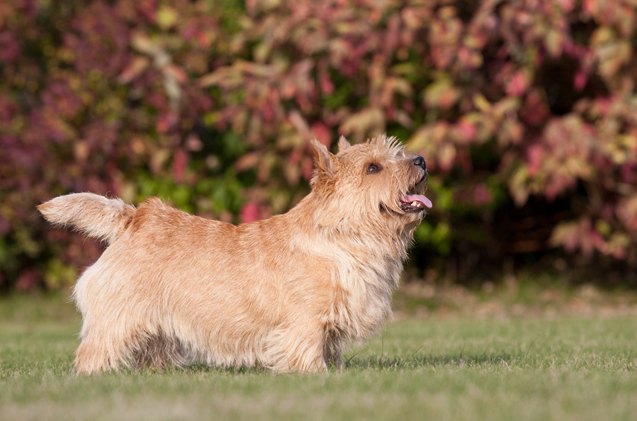
Active, friendly, affectionate, energetic, amusing, and always ready for an adventure, the Norwich Terrier is a small breed that’s also full of willfulness and intelligence. Closely related to the Norfolk Terrier, this dog loves chasing rats and mice. But the Norfolk and Norwich Terrier do have its differences – just look at its ears. Norwich Terrier ear’s are pricked up and stand straight on the its head while the Norfolk Terrier has drooped ears.
If you’ve got a good sense of humor and are always on the lookout for adventure, the Norwich Terrier is the dog for you. Read on to find out more about this fascinating breed.
Active, friendly, affectionate, energetic, amusing, and always ready for an adventure, the Norwich Terrier is a small breed that’s also full of willfulness and intelligence.
Origin
The Norwich Terrier originated in England in the 1800s. Back then, this dog was used as a rat catcher and as a hunting dog. Although its main role wasn’t for hunting purposes, the Norwich was used to find and uncover foxes that had hidden in underground holes. While it was busy with this task, the other hunting dogs would continue the chase. The Norwich Terrier’s main role was to hunt rats and mice in the stables.
In 1932, the Norwich Terrier was recognized as having two different ears types: folded or drooping, and pricked or straight. Later, the Norwich Terrier was distinguished as a separate breed from the Norfolk Terrier.
Pedigree
The Norwich Terrier was bred from Irish Terriers and perhaps from the Trumpington Terrier (a breed that no longer exists). Earlier on, it was also known as the Jones Terrier and the Cantab Terrier.
The Norwich Terrier was recognized by the AKC in 1936.
Food / Diet
Intelligent and willful – it’s a combination that makes the Norwich Terrier a somewhat challenging dog to train.
Training
Intelligent and willful – it’s a combination that makes the Norwich Terrier a somewhat challenging dog to train. In order to be successful, you must be patient to overcome this dog’s willfulness as well as make training sessions fun and exciting for your pooch. You’ll find that Norwich Terriers respond best to positive reinforcement training methods. If you use negative training methods, you won’t get far with the Norwich, thanks to its willful nature. Since your Norwich will be spending a lot of time on its leash, you’ll need to start proper leash training early.
Weight
Both male and female Norwich Terriers weight 11 to 12 pounds.
Temperament / Behavior
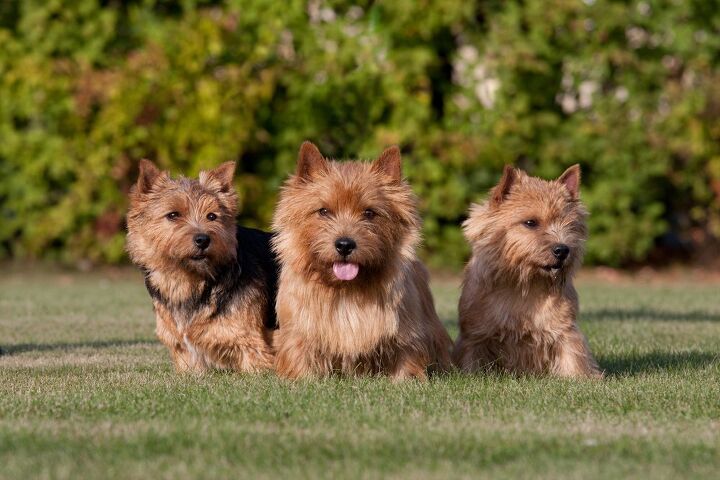
The Norwich Terrier is friendly and intelligent, and is always up for an adventure. Another positive is that this breed doesn’t exhibit some of the bad habits that terriers are known for, such as nervousness, a need to be alone, and excessive barking. Since the Norwich was bred for hunting and killing rats and mice, this dog likes to get outdoors where it can chase to its heart’s content. When you go beyond the confines of your fenced yard, be sure that your Norwich is on a leach. No matter how much training this breed gets its instinct to chase after smaller animals will always prevail.
The Norwich Terrier is a social breed, so be sure to start the process early if you have other animals in the house. The Norwich gets along well with children, but again, you’ll have to teach children should be taught not to be rough or rambunctious around the dog. As well, children should be supervised around the Norwich.
Common Health Problems
You should be aware of a few health conditions that are fairly common with Norwich Terriers. The Norwich is prone to many of the same diseases that are common in small breed dogs. Epilepsy is common, as are a variety of respiratory illnesses. Another genetic problem you should be on the lookout for in the Norwich Terrier is hip dysplasia.
Life Expectancy
Norwich Terriers have a life expectancy of 12 to 16 years.
Exercise Requirements
The Norwich Terrier can get exercise on its own, as long as you have a fenced-in yard. As long as you have the time and space, and ensure that your Norwich gets enough exercise, you’ll avoid destructive behaviors. Your Norwich Terrier will need other exercise as well, like a daily walk. Be sure to keep your dog on a leash, as the Norwich will chase after animals such as rabbits and squirrels. Your backyard should be completely fenced in for the same reason. Your dog enjoys a game of tug of war or chase. Don’t be alarmed if your Norwich is aggressive when it is playing – it’s perfectly natural.
The Norwich Terrier is friendly and intelligent, and is always up for an adventure.
AKC
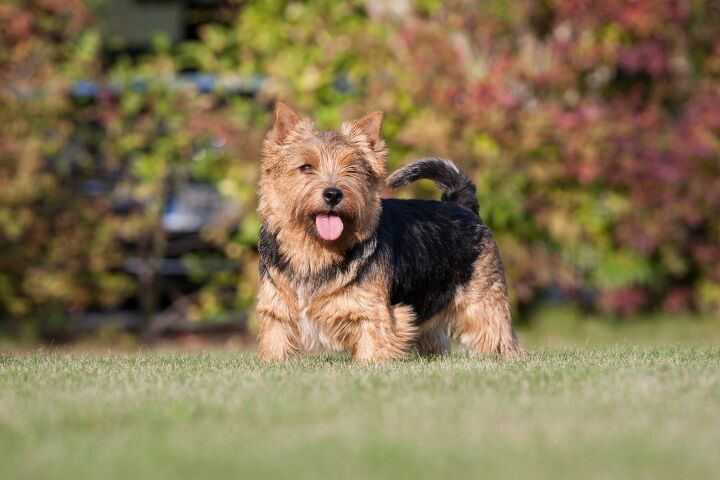
The American Kennel Club says this about the breed: “Spirited and stocky with prick ears and a slightly foxy expression, the Norwich Terrier is one of the smallest working terriers. Despite his small size, the Norwich has good substance and is an eager worker. The breed’s wiry, weather resistant coat can be red, wheaten, black and tan or grizzle.”
Coat
The Norwich Terrier has short hair all over its body and is best kept natural, which means it needs brushing but no trimming. For the most part, its hair is thick, coarse and wiry, except on the face, where is it softer. The breed has a double coat, and the under coat is softer than the outer coat.
In the way of color, the Norwich Terrier can be any shade of red, as well as black and tan or gray.
Puppies
Since the Norwich Terrier is a willful breed, training should start as soon as your puppy comes home. This dog is a bundle of energy, so play with your puppy to tire it out.
Photo credit: Lenkadan/Shutterstock