Rhinelander Rabbit Breed History/Origin
The Rhinelander Rabbit originated in Grevenbroch, North Rhine-Westphalia, Germany by Josef Heinz and was first shown in 1902. To create the breed, Heintz crossed a Japanese buck (known as the Harlequin Rabbit in North America) with a gray-checkered doe. One of the litter’s kits was the first “Rhinelander,” sporting some of the same dual-colored markings we know today. Heintz then crossed the Harlequin with a Checkered Giant doe, which produced a desirable kit. It was with this litter that he decided to continue to breed, thus creating the Rhinelander rabbit, which was accepted as a breed in Germany in 1905.
These rabbits were brought to the United States in 1923 and accepted by the American Rabbit Breeder’s Association (ARBA) in 1925. The Rhinelander Rabbit disappeared from American and was only reintroduced in 1972, when Robert Herschbach of California attended a German show and purchased four animals for his rabbitry back home. The ARBA once again recognized the Rhinelander breed in 1975.
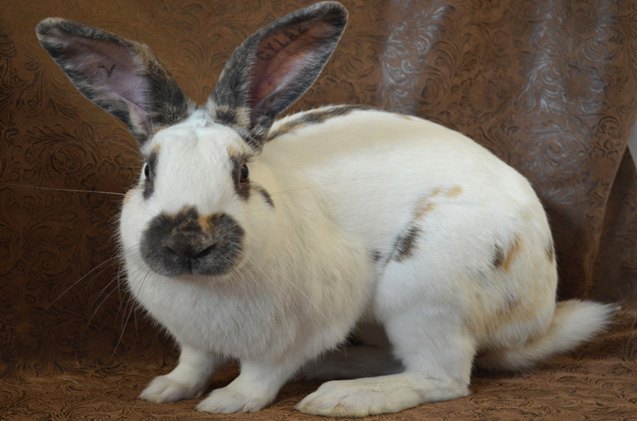
The Rhinelander Rabbit has a white base coat that, unlike any other rabbit, is decorated with two different colored markings.
Overall Description
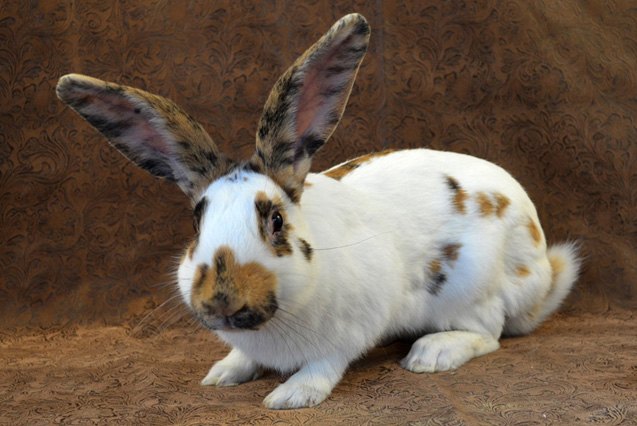
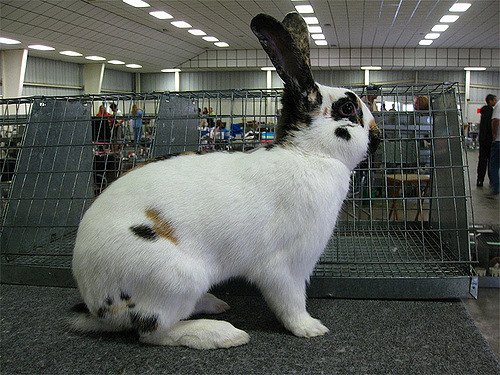
This breed has a full-arch body shape and weight anywhere between 6.5-10 lbs. once fully grown. Rhinelander Rabbits have long limbs and the same width from shoulders to hip. It also has long ears, measuring no longer than 4 3/4 inches and falling into a “V” shape.
Coat
The Rhinelander’s fur is soft, short and dense, and does not require much in order to keep it in shape. Owners should brush its coat once every other week during off-season shedding periods to remove any stray hairs. Rabbits have one or two yearly molts – during these times, you should brush your rabbit every week with a slicker brush in order to keep up with shedding. Under no circumstances should you bathe a rabbit, as this causes immense stress and can even lead to death. Instead, simply spot-clean its coat with a damp cloth.
Colors
The Rhinelander rabbit has a white base coat that, unlike any other rabbit, is decorated with two different colored markings. Like the English Spot, this rabbit breed must have colored ears, eye circles and a nose marking that resembles a butterfly, as well as a cheek spot below each eye. In order to be show-worthy, Rhinelanders must also have 2-10 spots on its flanks and hindquarters that are orange/yellow and black or, since 2012, fawn and blue.
Rhinelander rabbits must have colored ears, eye circles and a nose marking that resembles a butterfly.
Care Requirements
Like any rabbit, the Rhinelander’s diet must consist of 70 percent hay in order to stay healthy. The rest of its diet should be comprised of pellets and a select amount of fruits, vegetables and leafy greens. Always do your research before feeding your rabbit anything from your fridge, as some vegetables, leafy greens and fruits can be hazardous to your rabbit’s health.
This rabbit does well in either indoor or outdoor enclosures, however rabbits seem to be healthier overall when indoors (extreme weather conditions can have an impact on your rabbit’s overall health). Outdoor enclosures should be made of wire or wood and should be raised off the ground in order to protect rabbits from the elements, as well as potential predators. Indoor enclosures should be made of wire, and have a solid bottom to hold bedding tjat needs to be spot-cleaned everyday and completely replaced at the end of every week.
Health
Rhinelander rabbits are not at-risk for any particular diseases, however there are some health issues that rabbits are susceptible to. Rabbit teeth never stop growing, and a diet high in hay is the only thing that will naturally wear teeth down. If the rabbit’s diet does not consist mainly of hay, the rabbit’s teeth begin to grow into its jaw and/or face and will be extremely painful. A quick trip to the veterinarian (and a long-term solution of changing its diet) will remedy this problem.
Outdoor rabbits that do not have sanitary cages may also develop flystrike. This is a painful condition when flies lay eggs in the rabbit’s coat. In order to prevent this, always spot-clean your rabbit and keep cages in clean condition.
Bucks can be neutered as young as three and a half months old, while does can be spayed at 4-6 months old.
The Rhinelander Rabbit’s docile, patient nature will make for a wonderful first-time pet.
Temperament/Behavior
While not impossible, most rabbits are more challenging to potty train than your average dog or cat. Many rabbit owners have found success in placing several litter boxes across their home. With plenty of patience and rewards, your rabbit will understand the basics of potty training.
In order to be properly socialized, remember to take your Rhinelander Rabbit out of its enclosure for a minimum of four hours per day. Like other pets, rabbits need plenty of time outside of the enclosure to interact with people and other animals. Rhinelanders are ideal family pets for singles, couples, seniors and families with children, as long as kids are taught how to pick up and care for rabbits. The Rhinelander’s docile, patient nature will make for a wonderful first-time pet.
When it comes to toys, each rabbit has its own personal preference. It is all up the owner to figure out what their rabbit prefers to play with.
Photo credit: albc-usa; rabbit_mage/Flickr