Spotted Saddle Horse Breed History
The Spotted Saddle Horse breed traces its roots all the way back to the horses that were able to escape from ships that crashed upon the shorelines of the United States. The horses were usually spotted in appearance, as well as naturally gaited, and they were strong with a high level of stamina. These features prompted humans to start using them in war.
At the end of the Civil War in the United States, a lot of the imported horses that were considered gaited were left behind. By selectively breeding these gaited horses, a new, colorful, and smooth gaited equine breed was produced, and it was named the Spotted Saddle Horse.
The Spotted Saddle Horse has a comfortable, smooth gait.
Over time, other breeds, such as the Mustang, the Standardbred, Missouri Fox Trotter, Paso Fino, Racking Horse, and Peruvian Paso ended up playing a role in the Spotted Saddle Horse breed’s development. More recently, the Tennessee Walking Horse has helped to strengthen the genetics necessary for the preservation of the smooth gait of the Spotted Saddle Horse.
The Spotted Saddle Horse Breeders and Exhibitors Association, which is also known as the SSHBEA, was set up in 1985 in order to promote the breed. It established rules for both registering and showing the Spotted Saddle Horse.
The National Spotted Saddle Horse Association, also referred to as NSSHA, was created in 1979, and the American Spotted Horse Association was set up in 1999 to support the breed.
Today, this breed is popular because of its temperament and ability to complete a variety of tasks.
Breed Traits
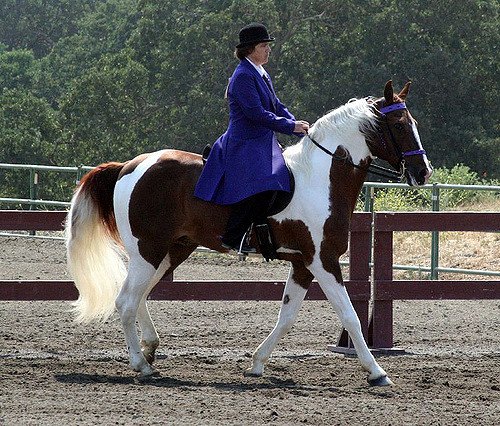
The Spotted Saddle Horse is popular for more than just its beautiful appearance. This breed is also known for its endearing personality.
You can expect these horses to be docile and gentle, as well as kind. They are a pleasure to work with because they are friendly and social, and they make wonderful companions to riders of all levels.
Also, these horses can be trained for various tasks, so you can work with a Spotted Saddle horse to enter dressage competitions or to simply enjoy a comfortable ride along a trail.
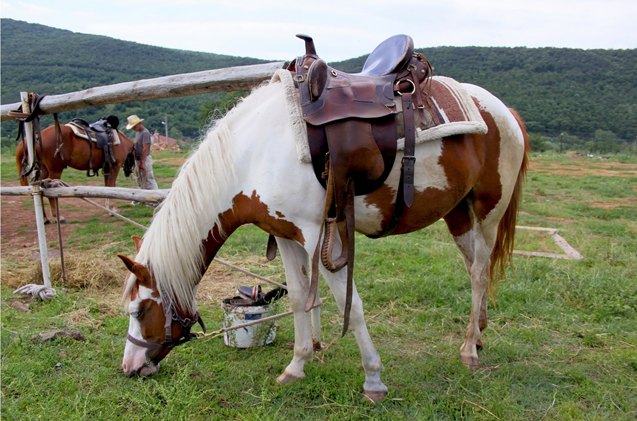
Every Spotted Saddle horse has a different coat pattern, making each one unique.
Overall Description
Overall, when you look at a Spotted Saddle Horse, you may notice that it resembles the Tennessee Walking Horse. However, it is a bit stockier and smaller in its build.
One of the popular features of the Spotted Saddle Horse is its easy and smooth gait, which makes it a pleasure to ride. These horses are also athletic, and they feature a distinct coat pattern that makes them stand out against other equine breeds.
Those seeking a family pet that will be a pleasure to ride and that has an even temperament will enjoy working with the Spotted Saddle Horse. In fact, both young and old riders can bond with these horses easily.
The head should be refined, moderate in length, and slightly convex or straight. There should be a gentle and soft expression in the face, as well as in the eyes, which are set wide. The ears are moderately long, and they feature inner tips that are hooked. The jaw will taper to a fine muzzle, and the neck will be slightly arched, moderate in length, muscular, and carried high.
This horse’s shoulders will be muscular, sloping, and long. The withers will be fine, high, and will extend well into the horse’s back. The chest will be muscular as well, and will feature a moderate width.
The Spotted Saddle Horse will have a smooth and comfortable four-beat gait, and these horses do not trot.
The Spotted Saddle Horse has a beautiful appearance and endearing personality.
Colors
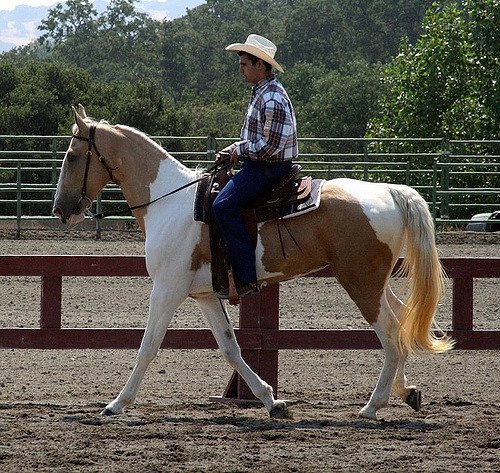
The Spotted Saddle Horse features a truly beautiful and colorful coat. Every horse has a different coat pattern, making each one unique.
There is a wide range of colors and patterns that are considered acceptable for the breed. In fact, all horse colors, as long as they have some white on the body, are acceptable. Patterns include pinto, tobiano, overo, tovero, and sabino.
Also, many of these horses will feature white hooves, though some will also have black stripes in their hooves.
Grooming Requirements
Regular grooming sessions are necessary to bond with your Spotted Saddle Horse and keep its coat shiny, healthy, and smooth. A standard equine grooming practice should be sufficient.
Using a curry comb, remove any debris and loose hair, including dirt, from your horse’s coat. Then use a dandy brush to remove any extra debris and hair that the curry comb did not get rid of. Follow that up with a body finishing brush, which can be particularly helpful on the horse’s legs and face, as those are more sensitive areas. A standard shedding blade can further remove loose hair, if necessary, and you can keep the horse’s mane and tail tangle-free with the help of a mane comb and tail brush. Don’t forget to also use a hoof pick to thoroughly clean out the animal’s hooves while checking for infections or injuries.
Photo credit: Cherydi/Depostphotos.com; Jean/Flickr